Alert 08.24.26
Texas Data Center Interconnections Face New Audit Gate After Governor Abbott Directive (UPDATE)
Texas has not closed the door on data center development, but has moved to a proof-of-readiness model.
Alert
Alert
09.01.26
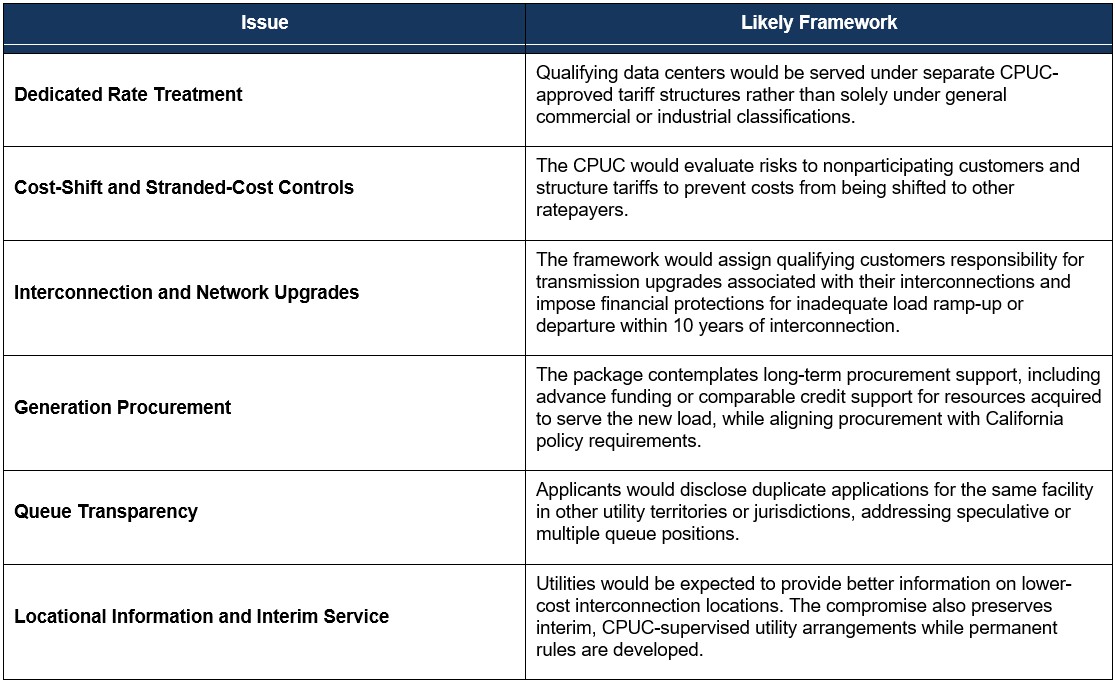
On August 28, 2026, California lawmakers announced a late-session compromise with Gov. Gavin Newsom’s participation on two bills addressing the electricity demands of data centers. The bills now head to the Governor’s desk for signature after passing both houses on August 31, 2026, the final day of the California legislative session. The package responds to ratepayer concerns over generation and grid-upgrade costs associated with data center development while avoiding a statewide moratorium on such development overall. The principal measures are Senate Bill (SB) 886, introduced by Senators Steve Padilla and Jerry McNerney, and Assembly Bill (AB) 2383, introduced by Assemblymember Rick Chavez Zbur. The final package requires the California Public Utilities Commission (CPUC) to create special rates and updated rules for data-center electricity use, including assigning qualifying data centers responsibility for grid upgrades triggered by their interconnection.
Core Elements of the California Package
Implications for Developers and Hyperscalers
Implications for California Electric Utilities
How California Compares with Other Major State Initiatives in Texas and New York
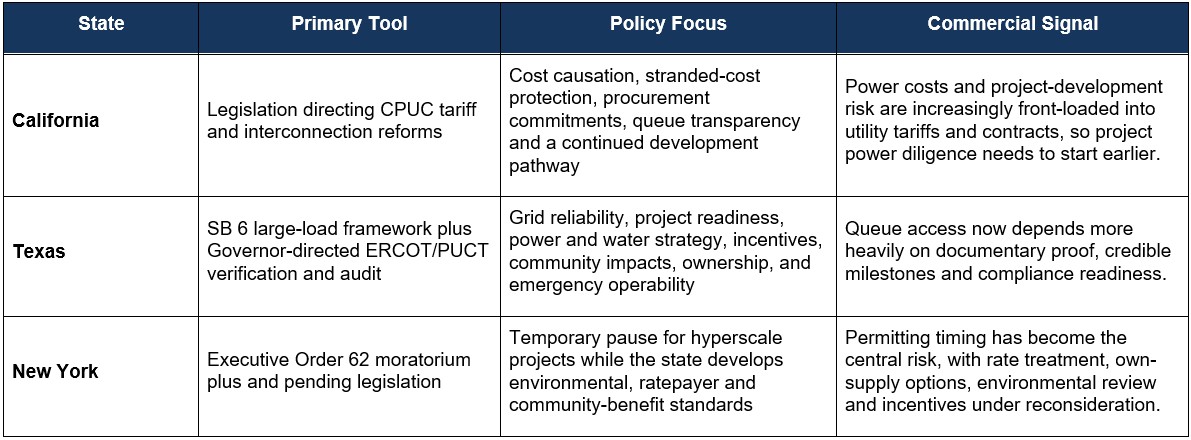
Texas. Texas enacted SB 6 in 2025 and, on August 3, 2026, Gov. Greg Abbott directed Public Utility Commission of Texas (PUCT) and Electric Reliability Council of Texas (ERCOT) to verify and audit data centers advancing through ERCOT’s interconnection process. The review calls for information concerning incentives, electricity supply and demand, water and cooling, community mitigation, and ownership. PUCT later allowed ERCOT to proceed under modified Batch Zero procedures while conducting verification.
New York. Gov. Kathy Hochul issued Executive Order 62 on July 14, 2026, temporarily pausing specified state environmental permits for new hyperscale data centers while the state develops a generic environmental impact statement and a broader regulatory framework. New York also is pursuing utility rate and cost-allocation reforms and reconsidering incentives. The Legislature separately passed the Responsible Data Center Development Act, but that bill has not yet been signed by Gov. Hochul.
The broader trend. California, Texas and New York use different legal tools, but point toward the same national baseline: Large data-center loads increasingly must demonstrate project maturity, bear identifiable system costs, provide stronger long-term commitments, and address power, water, environmental and community impacts. California’s negotiated model is less restrictive than New York’s moratorium and more tariff-centered than Texas’s audit, but all three approaches reduce the value of a queue position unsupported by commercial readiness.
Pillsbury Perspective
California is choosing managed growth rather than a statewide moratorium. The policy bargain is a clearer development pathway in exchange for tighter cost causation and stronger commitments. For credible, well-capitalized projects, dedicated tariffs may ultimately improve visibility into service requirements and reduce the risk that speculative requests consume scarce planning capacity. But the transition period will carry execution risk as project economics depend on evolving tariff, upgrade-cost, procurement and power supply requirements.
Developers, hyperscalers, utilities, lenders and power suppliers should work from a common project record that reconciles site control, megawatt ramp, interconnection studies, procurement assumptions, credit support, water and cooling design, local approvals, and contractual milestones. Transactions should include change-in-law and regulatory-delay mechanisms broad enough to capture both final legislation and subsequent CPUC implementation.
Immediate Action Checklist for Data Center Developers, Hyperscalers and Utilities