Alert 09.28.26
Alert
SEC Proposes Sweeping Executive Compensation Disclosure Reforms
Alert
Takeaways
11.23.26
The SEC’s executive compensation disclosure framework has been developed through successive rulemakings, including the comprehensive 2006 amendments and subsequent Dodd-Frank Act requirements. The current rules require public company issuers to provide detailed compensation tables, narrative explanations, and specialized disclosures concerning pay versus performance, pay ratio, and compensation recovery.
On November 13, 2026, the Securities and Exchange Commission (SEC) proposed significant amendments to the executive and director compensation disclosure requirements of Item 402 of Regulation S-K and related rules and forms (the proposed amendments together with the proposing release, the “Rule Proposal”). The Rule Proposal follows the SEC’s recent proposals to simplify the public company reporting framework and reduce compliance burdens while maintaining disclosure of material information for investors, including its May 19, 2026, proposals to simplify filer status and expand Form S-3 eligibility and its proposal to permit optional semiannual reporting.
The Rule Proposal would focus the disclosure on the material information relevant to assessing the compensation of named executive officers (NEOs) and directors. Under the Proposed Rule, issuers would have greater flexibility in how they present that information but would remain responsible for providing the material information necessary for investors to understand the required tables and related disclosures.
The public comment period will remain open for 60 days following publication of the Rule Proposal in the Federal Register.
Highlights
- No change for 2027 proxy season. Issuers should prepare upcoming proxy statements in compliance with the current rules. Even after adoption, early use would be all-or-nothing; issuers could not select only favorable changes.
- Less disclosure over time, but real transition work. Fewer NEOs and fewer tables should reduce recurring burdens, but the new tables would require different data (such as award-by-award tracking and value realized at vesting and exercise).
- Smaller reporting companies (SRCs) and emerging growth companies (EGCs) would not be spared the new tables. SRCs and EGCs would retain key accommodations, including exemptions from CD&A and pay ratio disclosure, but would also transition to the new compensation tables.
- Pay stories will look different. Earned compensation could spike in years when legacy awards vest or options are exercised, without any new grant. Compensation committees will need to plan how to explain these swings to investors.
- Perquisite programs may be revisited. The higher threshold and revised guidance could give issuers more room on executive security and aircraft use, but determinations must be reasonable and in good faith and should be documented. Valuations used in the proxy could also align with values used for tax purposes.
- Investor expectations may outpace the rules. Investors and proxy advisory firms may continue to expect disclosure about other senior executives, metrics, severance arrangements and other “material” compensation terms, so issuers should weigh any reductions against shareholder engagement.
- Incentive plan metrics. Issuers using non-GAAP performance measures would face new reconciliation and explanation requirements, which may be relevant to upcoming incentive plan design.
- Clawback policies unchanged. Disclosure would be simplified, but recovery obligations under Rule 10D-1 and exchange listing standards would not change.
Proposed Executive Compensation Disclosure Changes at a Glance [PDF]
Key Elements of the Rule Proposal
- Fewer named executive officers. For all registrants, including SRCs and EGCs, NEOs would consist of all individuals who served as principal executive officer (PEO) or principal financial officer (PFO), or acted in a similar capacity, during the last completed fiscal year. In most cases, this would mean the CEO and CFO, rather than the five or more NEOs (or three or more for SRCs and EGCs) typically covered under the current rules. Interim officers, individuals serving jointly as CEO, and individuals who served for only part of the year would remain covered, so the number of NEOs could exceed two. Because other rules refer to NEOs, the change would also narrow related requirements; for example, Form 8-K Item 5.02(e) reporting of new or materially amended compensation arrangements would be limited to the PEO and PFO. However, requirements that apply to a broader group of officers, such as Section 16 reporting and Section 162(m) “covered employee” determinations, would continue to require monitoring of compensation for executives beyond the PEO and PFO.
- Three new primary compensation tables. The Summary Compensation, Grants of Plan-Based Awards, Outstanding Equity Awards at Fiscal Year-End, and Option Exercises and Stock Vested Tables would be replaced with three new tables as described below, and eliminate the separate Pension Benefits and Nonqualified Deferred Compensation Tables. The three new tables would distinguish compensation opportunities from compensation outcomes and track equity awards between those points.
How the Compensation Tables Would Change
Proposed Rule — amendments subject to adoption of the Proposed Rule
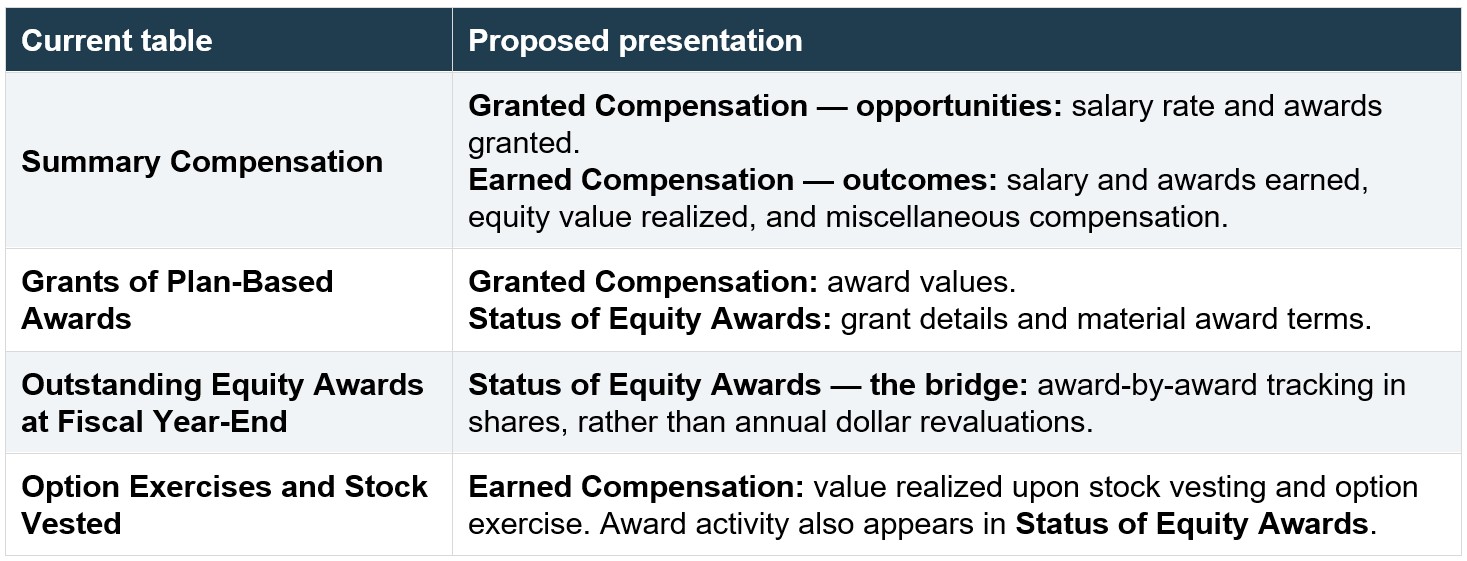
Separate tables eliminated: Pension Benefits and Nonqualified Deferred Compensation. Relevant amounts and material information would remain reportable under the new framework.
- Earned Compensation Table. A new Earned Compensation Table would present salary earned, non-equity awards earned, the value realized upon vesting of stock awards and exercise of option awards, miscellaneous compensation received, and total compensation earned. Miscellaneous compensation would include perquisites (subject to the proposed $150,000 aggregate threshold discussed below), tax gross-ups, contributions to defined contribution and nonqualified deferred compensation plans, above-market earnings on deferred compensation, service costs under defined benefit pension plans, severance and other termination or change in control payments, life insurance premiums, dividends on outstanding equity awards, and any other compensation the issuer determines is material or elects to disclose. Unlike the current “All other compensation” column, issuers would not need to capture immaterial items outside these categories or provide detailed footnotes. Equity awards would be reflected when stock awards vest or options are exercised, including awards granted in prior years, rather than at grant date value as currently required in the Summary Compensation Table.
- Granted Compensation Table. A new Granted Compensation Table would present annualized salary as of fiscal year-end, non-equity awards at target value, and stock and option awards at grant date fair value calculated under ASC Topic 718 but assuming target outcomes.[1] Because current rules value performance awards based on the probable outcome, the target assumption could produce amounts that differ from the accounting values in the financial statements, particularly for awards with market conditions or targets that are not considered probable. Where target and probable outcomes diverge materially, such as for a “moonshot” award, supplemental disclosure would be required.
A non-equity award earned in one year but granted after year-end would be reported in the year earned. For example, a discretionary cash bonus granted in February 2028 for 2027 performance would be reported as 2027 compensation. For equity awards, an issuer could elect to report awards granted in the first fiscal quarter as compensation for the immediately preceding fiscal year if it considers the awards to relate to performance in that year. For example, a calendar-year issuer that grants performance stock units in February 2028 in recognition of 2027 performance could report those awards as 2027 compensation in its 2028 proxy statement. The election would have to be applied consistently across all years presented and disclosed, and the Status of Equity Awards Table would then be presented as of the end of that first quarter (or an earlier practicable date). The Rule Proposal notes that the election flexibility is intended to address concerns about timing mismatches between how annual bonuses and equity awards are reported under the current rules.
- Status of Equity Awards Table. A new Status of Equity Awards Table would show, on an award-by-award basis, the grant date, award type, number of shares granted (or the threshold, target, and maximum range), end of any performance period, final vesting date, exercise price, and number of shares vested, exercised, or expired. Information would generally be presented as of the end of the last completed fiscal year (or as of the end of the following first fiscal quarter if the issuer elects to report early-year grants in the prior year), and issuers would disclose the “as of” date. Awards would be shown in number of shares rather than dollar values, eliminating the annual revaluations required for the current Outstanding Equity Awards at Fiscal Year-End Table. Related disclosure would explain vesting schedules and material performance, market, and service conditions.
The table is intended to bridge the Granted and Earned Compensation Tables by tracking each award from grant until it vests, is exercised, or expires.
One Option Grant, Different Reporting Years
Proposed amendments — subject to adoption
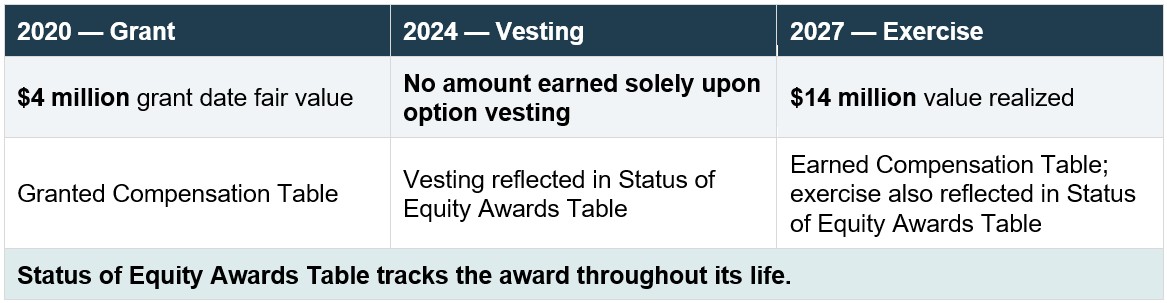 Source: SEC proposing release, Release No. 33-11455 (Nov. 13, 2026), illustrative example.
A large earned compensation amount may reflect an award granted years earlier. In the SEC’s example, options granted in 2020 produce $14 million of earned compensation when exercised in 2027.
The example involves two million options with a $10 exercise price, exercised when the stock price is $17. Options enter earned compensation upon exercise; stock awards upon vesting.
The Earned and Granted Compensation Tables generally would cover three completed fiscal years, with two years for SRCs and EGCs, and accommodations for newly reporting issuers. Issuers would also have flexibility in presentation. For example, the Rule Proposal notes that an issuer could split a column into multiple columns or a supplemental table (such as separating annual cash bonuses, ad hoc cash bonuses, and multiyear cash incentive awards), omit a column with nothing to report, and present supplemental information in footnotes, narrative, or additional tables. Issuers could also voluntarily include additional executives in the tables without those individuals becoming NEOs, provided the tables are completed in full for each such executive. Because issuers would remain responsible for disclosing material information necessary to understand the tables, eliminating a prescribed table, footnote, or example topic would not necessarily eliminate disclosure of the underlying subject where material.
-
More flexible perquisite disclosure. The Rule Proposal would increase the aggregate annual reporting threshold for perquisites and personal benefits from $10,000 (established in 2006) to $150,000 per NEO. It would also allow issuers to exclude from tracking, and from the threshold calculation, any individual benefit that qualifies as a de minimis fringe benefit under Internal Revenue Code Section 132(a)(4). Because the exclusion relies on an existing tax standard rather than a new SEC dollar limit, the SEC does not expect to issue further guidance on the exclusion. The exclusion would be optional, so issuers not subject to U.S. tax could either apply the tax definition solely for this purpose or continue to track all perquisites.
The Rule Proposal would also revise the SEC’s interpretive guidance under the existing two-part perquisite analysis. Under the first prong, an item would not be a perquisite if the issuer reasonably determines, in good faith, that it is integrally and directly related to the performance of the executive’s duties. The business purpose of the perquisite could be considered as a factor in that determination. The SEC would also rescind the examples from its 2006 guidance of items requiring disclosure as perquisites, such as security at an executive’s personal residence or during personal travel, executive commuting expenses, professional services provided to executives, and personal use of company property, vehicles, or other assets. The Rule Proposal specifically notes that an issuer acting in good faith could reasonably conclude that providing personal security services at all times, or requiring an executive to use company aircraft for personal travel due to security concerns, is integrally and directly related to the executive’s duties and therefore not a perquisite.
The Rule Proposal would also eliminate the requirement to value perquisites at aggregate incremental cost to the issuer. Under current guidance, issuers may need to attribute a different value to the same benefit for securities law purposes than for federal income tax purposes. Issuers could continue to use aggregate incremental cost but would have flexibility to use other valuation approaches, including values already determined for tax purposes, avoiding the need to revalue a benefit solely for proxy disclosure.
-
Principles-based CD&A. Issuers that are required to provide CD&A disclosure would address three core topics: the objectives of the compensation program in relation to corporate strategy; material compensation elements and how amounts are determined; and, if applicable, whether and how the most recent say-on-pay vote affected compensation policies and decisions. The Rule Proposal would reduce the required topics from seven to three and remove the current list of 15 illustrative topics, while retaining the requirement for tailored discussion of the issuer’s material compensation policies and decisions.
-
New non-GAAP disclosure requirements. The Rule Proposal would add requirements for non-GAAP target levels and company-selected financial performance measures that would apply to Item 402 disclosure generally, not only to the CD&A. As under the current rules, these disclosures would remain exempt from Regulation G and Item 10(e) of Regulation S-K, the SEC’s general rules governing the use and presentation of non-GAAP financial measures. However, non-GAAP targets or company-selected measures based on historical results would require a quantitative reconciliation to the most directly comparable GAAP measure, and projected non-GAAP targets would require a narrative description of how the measure is calculated from the issuer’s audited financial statements. Issuers would also need to explain why the non-GAAP measure is more appropriate than a GAAP measure for determining compensation or showing the relationship between pay and performance. Issuers could still omit target levels where disclosure would cause competitive harm.
-
Simplified pay versus performance disclosure. The Rule Proposal would replace the current “compensation actually paid” calculation with the total compensation earned column from the Earned Compensation Table, eliminating the recurring adjustments to equity fair values required under the existing methodology. Required disclosure would cover the PEO and PFO for the issuer’s last three completed fiscal years and describe the relationship between their compensation and the issuer’s cumulative total shareholder return (TSR).
Company TSR would be the only mandatory performance measure. The Rule Proposal would eliminate required peer group TSR and GAAP net income comparisons and the tabular list of three to seven performance measures, and a company-selected financial performance measure would become optional. The revised rule would permit flexibility in presenting the required relationship disclosure rather than retaining the current prescribed pay versus performance table. The disclosure period would also be reduced from five years (three for SRCs) to three years for all issuers, aligning it with the period covered by the other compensation tables. The SEC noted that investors seeking a five-year view could refer to prior years’ filings.
-
Revised pay ratio methodology. For issuers subject to pay ratio disclosure, the employee population used to identify the median employee would be limited to U.S. employees who work full time, excluding seasonal and temporary employees. The median employee would be identified at least once every five years, rather than every three years. Annual total compensation for the PEO and median employee would be determined using the methodology of the Granted Compensation Table, rather than the Summary Compensation Table. The Rule Proposal would also simplify instructions and related explanatory disclosures.
-
Termination and change in control arrangements. The Rule Proposal would eliminate prescriptive quantification of hypothetical termination and change in control payments in annual compensation disclosure. Issuers would instead describe the material terms of written and unwritten arrangements for individuals who served as PEO or PFO during the year. This narrative requirement would also apply to SRCs and EGCs.
-
Separate but more limited golden parachute disclosure. Golden parachute disclosure in connection with a merger or similar transaction would remain a separate requirement where applicable, but would cover only the PEO and PFO. The Rule Proposal would streamline the Golden Parachute Compensation Table by consolidating several columns into a single miscellaneous column, leaving cash, equity, miscellaneous, and total columns in addition to the NEO’s name, and would replace prescriptive footnote and narrative requirements with a principles-based narrative requirement. As a result, although annual proxy statements would no longer quantify hypothetical termination and change in control payments, a merger proxy or similar transaction document would still need to quantify the golden parachute payments each NEO would receive in connection with that transaction.
-
Reduced clawback disclosure. The Rule Proposal would remove both cover page checkboxes on Forms 10-K, 20-F, and 40-F concerning financial statement error corrections and compensation recovery analyses. It would also eliminate the required explanation of why a restatement did not require compensation recovery and simplify certain disclosures where recovery is impracticable.
Material disclosures about recovery would remain, and the Rule Proposal would not amend the underlying recovery obligations under Exchange Act Rule 10D-1 or the applicable exchange listing standards.
-
Streamlined director compensation disclosure. Issuers would continue to describe the material aspects of their director compensation programs and disclose compensation earned by each director. However, the Rule Proposal would eliminate the prescribed Director Compensation Table format, focus quantified cash and equity disclosure on compensation earned during the year, including value realized upon stock vesting and option exercise, and remove specified pension and deferred compensation requirements. Other director compensation, such as retirement contributions, tax gross-ups, consulting fees, and costs associated with director legacy programs, would be disclosed only where material, rather than regardless of amount. Issuers would also continue to disclose outstanding director equity awards, including grant dates, vesting schedules, and other material terms. Unlike the current rules, compensation an NEO receives for services as a director would be reported in the director compensation disclosure and excluded from the executive compensation tables.
-
Scaled disclosure and interaction with reporting reforms. SRCs and EGCs would be required to provide all three new primary tables, with two years of Earned and Granted Compensation Table information. However, SRCs and EGCs would remain exempt from CD&A and pay ratio disclosure. EGCs would remain exempt from pay versus performance and golden parachute disclosure. SRCs that are not EGCs would remain subject to those requirements under this Rule Proposal.
The Rule Proposal notes that the SEC’s separate May 19, 2026, filer status proposal would extend additional accommodations, including exemptions from pay versus performance and golden parachute disclosure and related advisory votes, to an expanded non-accelerated filer category that the SEC estimates would include approximately 81% of current registrants. The Rule Proposal anticipates coordination with that rulemaking but does not itself adopt those broader exemptions.
-
Inline XBRL changes. Large accelerated filers would be required to tag the three new primary tables in Inline XBRL, and other filers could do so voluntarily. Footnotes to those tables would not require tagging. Currently, only pay versus performance and clawback disclosures are tagged, and the Rule Proposal would eliminate those tagging requirements.
-
Other eliminated requirements. The Rule Proposal would eliminate Item 402(x), which the SEC adopted in December 2022 as part of its insider trading rule amendments. Item 402(x) currently requires narrative disclosure of policies and practices on the timing of option grants relative to the release of material nonpublic information, as well as tabular disclosure of certain option grants made close in time to such releases. The 2025 proxy season was the first in which calendar-year filers were required to include such disclosure. The SEC stated that the narrative disclosure has largely produced boilerplate, the tabular disclosure is rarely triggered, and the underlying information is generally available from other filings and market data. However, if an issuer presents option awards as granted “at the money” but has engaged in “spring-loading” or “bullet-dodging,” the new principles-based requirements would require disclosure of the relevant facts to the extent material.
The Rule Proposal would also eliminate Item 402(s), adopted in 2009, which requires discussion of compensation policies and practices for all employees to the extent they create risks reasonably likely to have a material adverse effect on the issuer. The SEC observed that this disclosure is often formulaic and noted that material compensation-related risks would still need to be disclosed under the risk factor and management’s discussion and analysis (MD&A) requirements of Regulation S-K. Issuers would also need to continue evaluating applicable antifraud obligations and other disclosure requirements.
-
Additional time to update compensation disclosure in registration statements. Amendments to Forms S-1, S-4, S-11, 10, and N-2 would permit omission of the most recently completed year’s Item 402 information until the earlier of (A) its disclosure in a filing under Exchange Act Section 13(a), 14, or 15(d), or (B) 120 days after fiscal year-end. The preceding required years would still need to be presented. If the registration statement is expected to become effective, automatically or at the issuer’s request, after that deadline, the issuer would need to file a pre-effective amendment adding the updated disclosure. For example, a calendar-year issuer filing a Form S-1 in February 2028 could omit its 2027 Item 402 information and instead present the three years immediately preceding 2027 (two years for SRCs), until the earlier of filing the 2027 information in its proxy statement or Form 10-K or 120 days after December 31, 2027. The Rule Proposal notes that this would give long-form registration statements the same 120-day period currently available for short-form registration statements, such as Form S-3. The Rule Proposal would also remove Item 5.02(f) of Form 8-K, which permits later reporting of salary and bonus amounts not calculable at the time of filing, as no longer necessary.
For answers to frequently asked questions about the SEC’s proposed executive compensation disclosure reforms, please visit our related FAQ.
[1] E.g., Achievement at specified percentage levels for awards with multiple potential outcomes (such as threshold, target, and maximum) or full achievement for awards that are either fully earned or not earned at all.
These and any accompanying materials are not legal advice, are not a complete summary of the subject matter, and are subject to the terms of use found at: https://www.pillsburylaw.com/en/terms-of-use.html. We recommend that you obtain separate legal advice.