Blog Post 05.26.26
Alert
Texas Data Center Interconnections Face New Audit Gate After Governor Abbott Directive
Texas has not closed the door on data center development, but has moved to a proof-of-readiness model.
Alert
Takeaways
08.18.26
What Happened
On August 3, 2026, Governor Greg Abbott directed the Public Utility Commission of Texas (PUCT) and the Electric Reliability Council of Texas (ERCOT) to conduct a comprehensive verification and audit of data center projects advancing through ERCOT’s interconnection process before additional projects are approved to move forward. The directive states that projects failing to comply with applicable PUCT, ERCOT and state-law requirements must be denied connection to the Texas power grid.
The directive was issued amid extraordinary queue pressure. The Governor’s letter cites approximately 474 GW of pending requests to connect to the ERCOT grid, more than five times Texas’s record peak demand, with approximately 90 percent of new power requests attributed to data centers.
The directive requires project-level information on public financial assistance, self-supplied or grid-supplied power, projected annual and peak electricity use, planned water consumption and cooling technology, community impact mitigation, and ownership and controlling interests.
ERCOT and PUCT Response
ERCOT responded immediately. In an August 3 Market Notice, ERCOT stated that it would not issue the planned August 7 Batch Zero classification notices and would seek a PUCT good-cause exception related to Batch Zero timelines and processes.
ERCOT filed good-cause requests on August 10 seeking relief from deadlines, including the classification deadline, treatment of certain projects in Quarterly Stability Assessments and timing for dynamic-data deficiency notices. PUCT discussed the implementation effort at its August 14 open meeting. PUCT is expected to take action on ERCOT’s pending requests at the August 20 open meeting.
The review mandated by Gov. Abbott appears to have two principal workstreams: a Batch Zero eligibility verification for large loads generally at or above 75 MW, and a community-impact information collection process for unenergized computational loads generally at or above 25 MW. Projects at or above 75 MW that are computational loads may be subject to both workstreams.
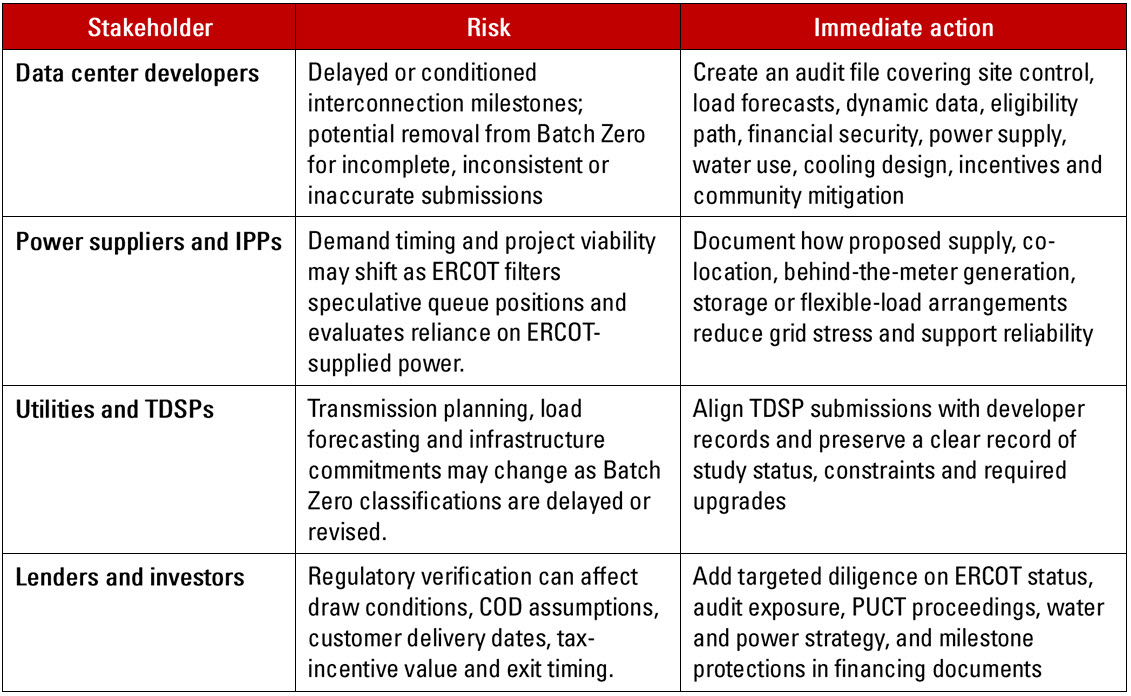
Key Risks by Stakeholder Group
Contracting and Diligence Implications
- Interconnection conditions. Treat successful completion of ERCOT verification and required PUCT approvals as express conditions to energization, financing draw and major procurement commitments where appropriate.
- Delay allocation. Allocate the risk of ERCOT audit delays among developers, customers, power suppliers and equipment vendors, including cure periods and extension mechanics.
- Power and water covenants. Build project-specific covenants around self-supply, demand flexibility, water-efficient cooling, reporting obligations and community mitigation.
- Confidentiality and public disclosure. Prepare for disclosure of ownership, incentives and resource-use information while protecting commercially sensitive information to the extent available under applicable law and process.
Salient Points
- Interconnection risk is now front-loaded. ERCOT, the wholesale power market operator for most of Texas, announced that it would not issue the planned August 7 Batch Zero classifications and would seek relief from the PUCT for good-cause while it implements Governor Abbott’s August 3 directive.
- Audit readiness matters. Developers should be prepared to provide evidence to support site control, eligibility attestations, load forecasts, financial assurance, power supply, water use, cooling technology, government incentives, community mitigation and ownership information.
- Power supply strategy is a competitive differentiator. Projects that bring new or behind-the-meter generation, self-supply some or all demand, use flexible-load arrangements, or procure dedicated supply are better aligned with the policy direction reflected in the directive and ERCOT’s large-load framework.
- Financing and customer agreements need schedule protection. Developers, lenders, hyperscale customers and power providers should revisit milestones, conditions precedent, delay rights and termination triggers tied to ERCOT approvals and energization.
Pillsbury Perspective
Texas remains attractive for data center and power infrastructure investment, but the policy signal is clear: Projects seeking access to ERCOT grid capacity must be able to prove readiness, pay their own way, protect local resources and support grid reliability. Well-capitalized projects with mature power, water, interconnection and community strategies may benefit if the audit process separates executable projects from speculative queue positions.
These and any accompanying materials are not legal advice, are not a complete summary of the subject matter, and are subject to the terms of use found at: https://www.pillsburylaw.com/en/terms-of-use.html. We recommend that you obtain separate legal advice.