Alert 02.27.26
Alert
Time Is Running Short to Update DFARS Covered Materials Clauses
Prudent contractors are amending contracts and subcontracts that incorporate Defense Federal Acquisition Regulation Supplement (DFARS) 252.225-7052 (MAY 2024) in advance of the January 1, 2027, deadline to minimize risk of schedule slip.
Alert
Takeaways
10.21.26
January 1, 2027, is less than three months away. On that date, Defense Federal Acquisition Regulation Supplement (DFARS) 252.225-7052 (MAY 2024) expands by its own terms, potentially making material in an organization’s stock compliant on December 31, 2026, and noncompliant one day later. A post-2026 delivery under an agreement containing that clause may be barred because of covered-country mining, refining or separation, even if the material was previously placed in inventory. Congress has changed the statutory upstream restriction to focus on the contract-award date, but contractors must still address any conflicting obligations in their existing agreements. There is a solution, however, that may delay impacts and give the supply chain more time to develop alternate sources for samarium-cobalt or neodymium-iron-boron magnets, tantalum, or tungsten, whose upstream supply chains involve a covered country.
The solution derives from Revision 1 to Class Deviation 2026-O0041, which established DFARS 252.225-7961 (JUN 2026). Section 7961 ties the expanded mining, refining and separation restriction to the date of contract award rather than the date of delivery. But the deviation is not self-executing contract language: It does not silently remove section 7052 from an executed agreement. Accordingly, contractors need to be proactive.
Why January 1 Matters for Contracts Containing Section 7052
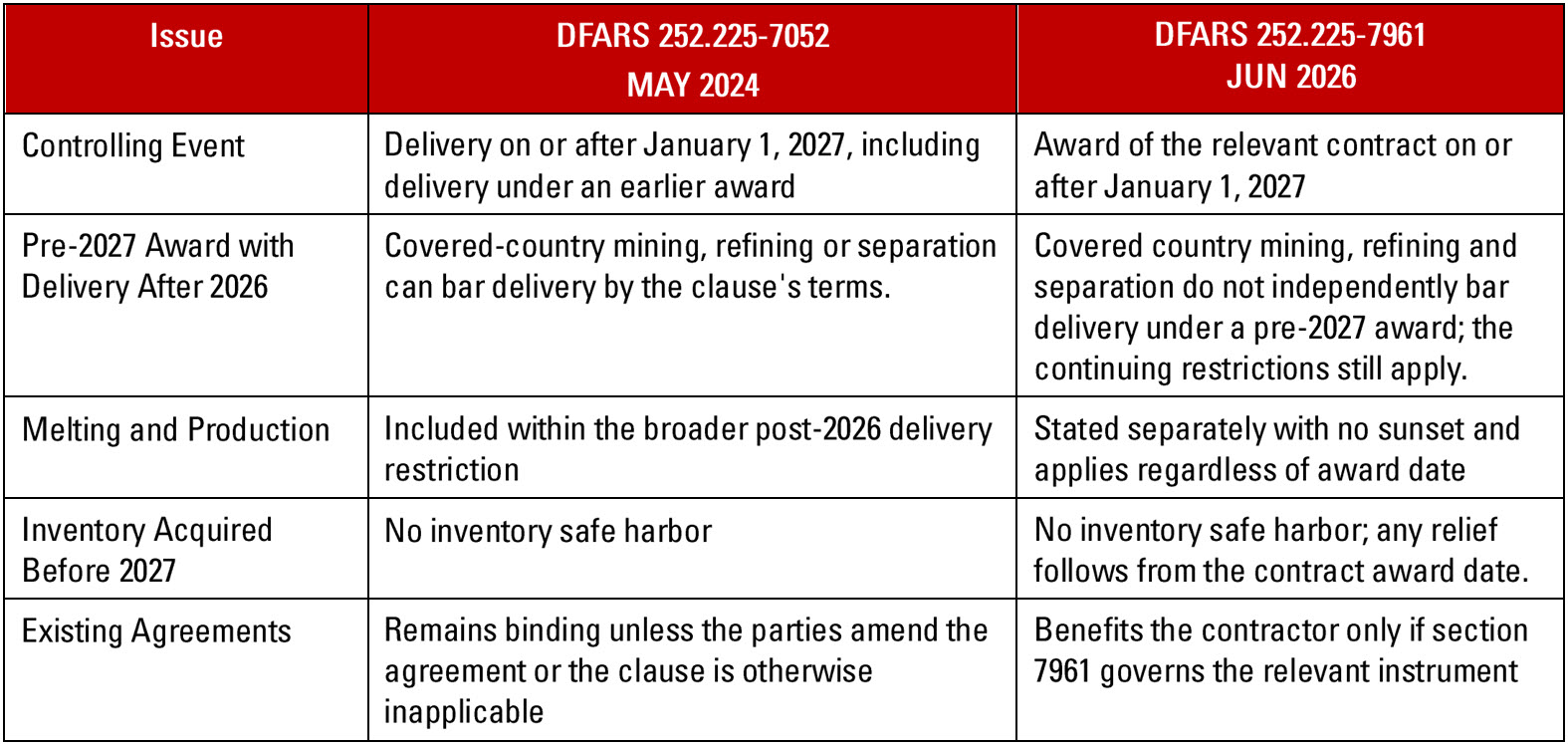
DFARS 252.225-7052 (MAY 2024) uses a delivery-date rule. Through December 31, 2026, it prohibits delivery of covered material melted or produced in a covered country and end items manufactured in a covered country that contain covered material. Beginning January 1, 2027, the clause adds mining, refining and separation to the restricted supply-chain stages. Because the clause applies that expanded rule to delivery under the contract, it can reach a 2027 delivery even when the contract was awarded and the material was placed in inventory years earlier.
The date on which a contractor bought the material does not create a safe harbor. Neither does the date of the applicable contract. If section 7052 remains in the governing instrument, a contractor must satisfy the clause as it reads on the delivery date or establish an applicable exception or authorized determination. That makes early 2027 deliveries the immediate concern and leaves little time to identify upstream sourcing, coordinate with customers and complete any necessary contract amendment.
How Section 7961 Changes the Timing Rule
Section 848 of the Fiscal Year 2026 National Defense Authorization Act revised the pending amendment to 10 U.S.C. section 4872 so that, beginning January 1, 2027, the expanded upstream restriction applies to contracts entered into on or after that date. Revision 1 implements that award-based structure through section 7961. Its mining, refining and separation restrictions apply only to delivery under a contract awarded on or after January 1, 2027. The clause separately retains the continuing prohibition on covered-country melting, production and certain end-item manufacture.
Sections 7052 and 7961 therefore differ in one critical respect: Section 7052 ties the expanded upstream restriction to the delivery date, while section 7961 ties it to the award date. That difference benefits a pre-2027 award only if section 7961 governs the instrument under which delivery occurs.
The Deviation Does Not Automatically Amend Existing Contracts
Revision 1 directs Department of Defense (DoD) contracting officers to use the deviation language for covered acquisitions, but Revision 1 does not itself rewrite an executed contract. Consistent with FAR 1.108(d), acquisition-rule changes generally apply prospectively and may be added to existing contracts by agreement. An existing prime contract, subcontract or purchase order that still incorporates section 7052 therefore should not be treated as if it already contains section 7961.
The same point applies down the supply chain. A modification to a prime contract does not automatically revise lower-tier agreements. Prime contractors must update affected flowdowns, and subcontractors should obtain written confirmation before assuming that an upstream change reaches their agreement. If sections 7052 and 7961 both appear in one instrument, section 7961 does not expressly nullify section 7052, and neither clause supplies a special order-of-precedence rule. The cleaner course is a written amendment that expressly deletes section 7052 and incorporates section 7961.
Which Contracts Need Attention Before 2027
- Pre-2027 award containing section 7961. The expanded mining, refining and separation restriction does not apply solely because delivery occurs after 2026. The other covered-material restrictions remain applicable.
- Pre-2027 award containing section 7052 (MAY 2024). Section 7052 expands on January 1, 2027, and may prohibit post-2026 delivery based on covered-country mining, refining or separation. This is the principal group requiring immediate attention.
- Agreement containing both clauses. Section 7961 does not expressly displace section 7052. The parties should remove the conflict through an amendment expressly deleting section 7052 and retaining section 7961.
The phrase “contract awarded” requires close attention for indefinite-delivery vehicles, task and delivery orders, options, major modifications, and lower-tier purchase orders. The FAR definition of contract includes accepted purchase orders and certain other instruments, while section 7961 does not provide a comprehensive rule for deciding when every later instrument is a new contract for this purpose. Contractors should identify the instrument under which delivery will occur, the clause incorporated into that instrument and its award date. A pre-2027 prime award may not determine the treatment of a lower-tier instrument awarded in 2027.
What Section 7961 Does Not Change
- There is no general inventory grandfather. The date the material was purchased, placed in stock or incorporated into an item is not the operative date. The statutory upstream restriction turns on contract award; compliance with an existing agreement also depends on the operative contract clause it contains.
- Covered-country melting and production remain restricted. A pre-2027 award is not a safe harbor for covered material melted or produced in a covered country, or for end items manufactured in a covered country that contain covered material, unless an exception or authorized determination applies.
- Other sourcing restrictions still apply. For example, samarium-cobalt magnets can also implicate the independent specialty-metals requirements in DFARS 252.225-7009. Compliance with section 7961 does not establish compliance with those separate rules.
What Contractors Should Consider Doing Now
Contractors have limited time to identify affected instruments and obtain amendments before their first post-2026 deliveries. December 31 is not necessarily an absolute deadline for executing every amendment, but section 7052 begins restricting affected deliveries on January 1. Contractors should not assume that an amendment completed later will cure deliveries made while the unamended clause governed. We recommend that contractors and subcontractors consider the following steps now:
- Prioritize post-2026 deliveries. Identify contracts, subcontracts, purchase orders, task orders and delivery orders involving covered materials that call for delivery on or shortly after January 1, 2027.
- Confirm the operative clause and award date. Record the exact clause number and date in each instrument and determine which instrument governs the delivery. Do not assume that the deviation, an upstream modification or a template update changed an executed agreement.
- Seek an express written amendment. For pre-2027 instruments that retain section 7052, request an amendment expressly deleting section 7052 and incorporating section 7961. If both clauses appear in an award, the amendment should resolve the conflict expressly.
- Coordinate through the supply chain. Prime contractors should review affected flowdowns, and subcontractors should coordinate with their customers before assuming that a prime-contract change reaches their agreements automatically.
- Preserve process-level traceability. Maintain evidence showing where mining, refining, separation, melting, production and end-item manufacture occurred. Section 7961 does not relax the continuing restrictions on covered-country melting, production or certain end-item manufacture.
- Prepare a fallback. If an amendment cannot be completed before the first affected delivery, evaluate compliant sources, applicable exceptions or a Government nonavailability determination rather than relying on the age of the inventory (while being mindful that Executive Order 14415 restricts certain section 4872 waivers beginning January 1, 2027).
DoD issued Revision 1 in July, and less than three months remain before section 7052 expands. For companies expecting deliveries early in 2027, the practical window for reconciling contract language is narrowing. Acting now can avoid a delivery interruption involving material that section 7961 might otherwise permit under a properly amended pre-2027 award.
These and any accompanying materials are not legal advice, are not a complete summary of the subject matter, and are subject to the terms of use found at: https://www.pillsburylaw.com/en/terms-of-use.html. We recommend that you obtain separate legal advice.