White Paper 08.04.26
White Paper
“A Tisket, a Tasket”: The U.S. Tax Court Wrecks Basket Option Tax Strategy
White Paper
By Mark Leeds
08.10.26
The Tax Court’s August 6, 2026, decision in SIH Partners LLLP[1] brought back a college memory of the three guys running what seemed to be a non-stop poker game in an on-campus dorm room. How could I know then that after graduation these risk jockeys would go on to form Susquehanna International Group (SIG), probably the most successful market maker on Wall Street? In the Tax Court case, SIG (through the named taxpayer) used a basket swap (a generally accepted risk mitigation strategy) to bolster a 10x after-tax return on a portfolio of Swiss stocks. But in an exceedingly rare instance, the smartest guys in the room (and certainly my alma mater) lost on the tax benefits from the trading strategy. This article looks inside the basket to unpack the trade and how the Internal Revenue Service (IRS) prevailed over traders whose specialty is trading strategies that “push legal boundaries” to reduce tax liability.[2]
A Short Primer on 70/30 Basket Swaps
A basket swap is a notional principal contract with multiple reference indices (often called components). In the basket swap used by SIH that is addressed in the Tax Court case, SIH had the right to, and did, vary the basket components.
[3] While basket contracts with variable components are treated as tax shelters by the IRS in other contexts, those rules were not implicated by the federal income tax strategy used by SIG in this case.[4] As discussed below, the diffusion of positions within a basket swap can prevent the swap itself from being considered an offsetting or successor position, as the case may be, with respect to physically held positions.
A corporation is entitled to a corporate dividend received deduction (DRD) with respect to a dividend only if it holds the dividend-paying stock unhedged for the 91-day period beginning 45 days before the dividend record date.[5] If a corporation holds the stock but also holds a derivative that offsets the stock and other positions, the issue becomes whether the offsetting derivative should be disaggregated. If the derivative is disaggregated, then the offsetting position in the derivative would prevent the corporation from meeting the holding period requirement for the long-stock position.
The IRS has a long-standing regulation addressing when derivatives with multiple components, such as a basket swap, will be evaluated on a look-through basis or as a single financial instrument.[6] Under this rule, if the swap references stocks with at least 20 unrelated issuers and it does not “substantially overlap” with a party’s positions outside the swap, the derivative is generally not disaggregated. The substantial overlap standard is met if the taxpayer’s positions outside the derivative are less than 70% of the positions referenced in the derivative. The derivative is skinnied down during testing to ensure that, at all levels, the substantial overlap standard is not violated. When swaps are used to mitigate risk in positions without the derivative being disaggregated, they are referred to as “70/30 basket swaps.” Although the market generally believed that 70/30 basket swaps were within the rule for derivatives, there was no direct authority on this issue. The SIH Partners decision is the first to address the issue directly and confirms that 70/30 swaps were within this rule.
While the substantial overlap rule was promulgated for determining the holding period for the corporate DRD, foreign tax credits (FTC),[7] qualified dividend income (QDI)[8] and straddles,[9] financial instrument tax practitioners believed that the substantial overlap standard was relevant for determining whether the holding period requirement was satisfied in other circumstances, as well. Specifically, practitioners concluded that a position included in a 70/30 basket swap would not be taken into account in determining whether a position in sold stock has been re-established under the wash-sale rules, whether a straddle exists, and a constructive sale has occurred.
As SIG found out, even when a 70/30 basket swap passes the substantial overlap test, the IRS can nonetheless treat such a swap as an offsetting position under an anti-abuse rule.[10] Under the anti-abuse rule, a 70/30 basket swap will be treated as an offsetting position if:
- Changes in the value of the 70/30 swap are “reasonably expected” to track changes in the value of the stock held by the taxpayer; and
- The position is held as part of a plan the principal purpose of which is to obtain tax savings the value of which is significantly in excess of the expected pre-tax economic profits from the plan.
Before the decision, practitioners had read the first prong as requiring a very high level of correlation between the derivative and the long-stock position. In SIH Partners, the Tax Court concluded that when the second prong of this test is met, the IRS is entitled to disaggregate the 70/30 basket swap and treat the offsetting components as directly offsetting the long-stock position held by the taxpayer.
The Facts of the SIH Partners Case
The SIH decision recites that a prominent investment bank proposed that SIG migrate its business hedge (called the Firm Hedge) to a basket swap with the bank. In addition to migrating the Firm Hedge, the bank suggested that SIG include short positions in four dividend-paying Swiss stocks. At the same time, SIG would acquire long positions in the Swiss stocks in the same size. When the Swiss stocks were blended with the Firm Hedge, the portfolio swap satisfied the requirements to be treated as a 70/30 basket swap. SIG executed the transactions in tandem. In other words, if the Swiss stock positions were disaggregated from the swap, SIG had no net opportunity for gain or loss from price movements in the Swiss stocks.
In 2012, SIG received gross dividends of $170 million on the four Swiss stocks. Under the swap with the bank, SIG made dividend equivalent payments of $130 million. As a result, SIG earned $40 million in net dividends. However, the $170 million of gross dividends were subject to Swiss withholding taxes of approximately $60 million. Swiss law allowed SIG to reclaim approximately for $35 million of the withheld taxes. On a net basis, SIG incurred approximately $25 million in Swiss taxes. Focusing solely on cash, using these rounded numbers and ignoring expenses, SIH Partners earned approximately $15 million in 2012 from the Swiss stocks (170-130-25=15), net of disaggregated payments on the swap attributable to the four Swiss stocks.
SIG claimed an FTC for the $25 million in Swiss withholding tax. The individual partners in SIH Partners treated the gross dividend as QDI. Although the opinion is silent on the point, it’s likely that SIG claimed an ordinary deduction for the $130 million dividend equivalent payment made to the bank. If these additional tax benefits are taken into account, using net-cash receipts as the measure, the after-tax profit on the transaction is as follows:
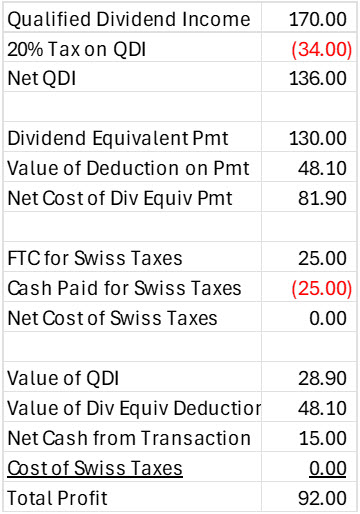
Our analysis (which ignores transaction costs) shows that the after-tax profit was approximately six times the pre-tax profit (92/15).[11] We note that the Tax Court did not determine the after-tax profit on the transaction in the same manner as we did directly above. Nonetheless, the Court’s analysis yielded a substantially similar result.
The bank swap met the mechanical requirements to be treated as a 70/30 basket swap. Because SIG obtained substantial tax benefits from the swap, the IRS vigorously pursued the argument that the swap should be disaggregated. On a purely technical basis, the Tax Court sided with SIG.
The 70/30 Basket Swap Anti-Abuse Rule
Although the Tax Court sided with SIG on the substantial overlap analysis, it held for the IRS on the application of the anti-abuse rule. As one would expect, the determination of whether the anti-abuse rule should apply was much more byzantine. This is inherent in the analysis because the anti-abuse rule looks to the taxpayer’s intent in at least two parts. First, it asks what the taxpayer reasonably expected from the transaction. Second, it asks whether the taxpayer had a principal purpose to obtain tax savings. The Tax Court dutifully recited both parties’ expert testimonies and weighed them before reaching its decision.
On the first prong of the anti-abuse rule (the “virtually tracks” rule) the Tax Court appeared to hold that such prong would always be met if any component in the 70/30 basket swap were identical to the physical positions held by the taxpayer. A tighter reading of this prong would have asked whether the basket swap, taken as a single financial instrument, was reasonably expected to bear a strong inverse correlation to the physical Swiss stock position.
The Tax Court’s analysis of the second prong of the anti-abuse rule is also interesting. SIG’s attorneys asserted that pre-tax profit should be interpreted to ignore the imposition of the Swiss withholding taxes (which would increase pre-tax profit). The Tax Court rejected this assertion. The anti-abuse regulation specifies that the expected pre-tax economic profits must be evaluated. The Tax Court interpreted this mandate to allow it to assume that the Swiss rebate for withheld taxes would be received as SIG expected to, and did, apply for the withholding tax refund. On this basis and factoring transaction costs into account, the Tax Court determined that SIG expected after-tax returns of 97 times, 12 times and 11 times the pre-tax returns for discrete dividends. This analysis, however, treats the FTCs as pure tax benefits. A lot of the difference between the Court’s determination of after-tax benefits and ours above relate to the fact that we used hindsight and the Court used the taxpayer’s pre-transaction estimates.
Salient Points
The plethora of experts with competing views on how pre- and post-tax profitability shows how uncertain the calculation can be. The simple cash-on-cash comparison that we provided above (assuming that the dividend equivalent payment could be fully deducted and the FTCs were utilizable in full) above wasn’t even directly considered by the Court. Nonetheless, under our hindsight analysis and the Court’s expectation analysis, the after-tax returns are a significant multiple of the pre-tax income from the 70/230 basket swap transaction. The decision is likely to stir debate about the efficacy of basket swaps for some time to come.
Mark Leeds regularly advises both buy-side and sell-side market participants on the tax aspects of financial product transactions. Mark extends his thanks to Matthew A. Stevens of Ernst & Young for his helpful comments and suggestions on an earlier version of this White Paper. Mistakes and omissions, however, remain the sole responsibility of the author.
[1] 167 TC No. 8
[2] Justin Elliott, Jesse Eisinger, Paul Kiel, Jeff Ernsthausen and Doris Burke (2022). "Meet the Billionaire and Rising GOP Mega-Donor Who's Gaming the Tax System". ProPublica. Archived from the original on March 14, 2023. Retrieved June 21, 2002.
[3] The opinion recites that SIG varied the basket components 214 times during 2012 alone.
[4] See Treas. Reg. § 1.6011-16; IRS Notice 2015-74.
[5] Section 245(c) of the Internal Revenue Code of 1986, as amended (the “Code”).
[6] Treasury Regulation § 1.245-5(c).
[7] Code § 901(k)
[8] Code § 1(h)(15)
[9] Treas. Reg. § 1.1092(d)-2(b)
[10] Treasury Regulation § 1.245-5(c)(iv).
[11] Our calculation assumes that the Swiss dividends constituted QDI, taxable at 20% to an individual, the dividend equivalent payment was deductible against ordinary income taxable at 37%, and the Swiss taxes could offset federal income tax on a dollar-for-dollar basis. The value of the QDI is excess of the amount received taxed at 20% versus the net amount that would have been received if the dividend was taxable at 37%.