Blog Post 04.03.26
Alert
Minnesota Extends Initial PFAS Reporting Deadline to September 15, 2026
Alert
Takeaways
04.20.26
State regulation of per- and polyfluoroalkyl substances (PFAS) continues to accelerate in 2026, with Minnesota and Maine leading the charge. As PFAS regulation from the federal government has slowed, states have driven a complex and rapidly evolving compliance landscape that affects manufacturers and retailers across industries. Regulated entities must brace themselves for initial reporting deadlines, with Minnesota’s first compliance deadline looming on September 15, 2026.
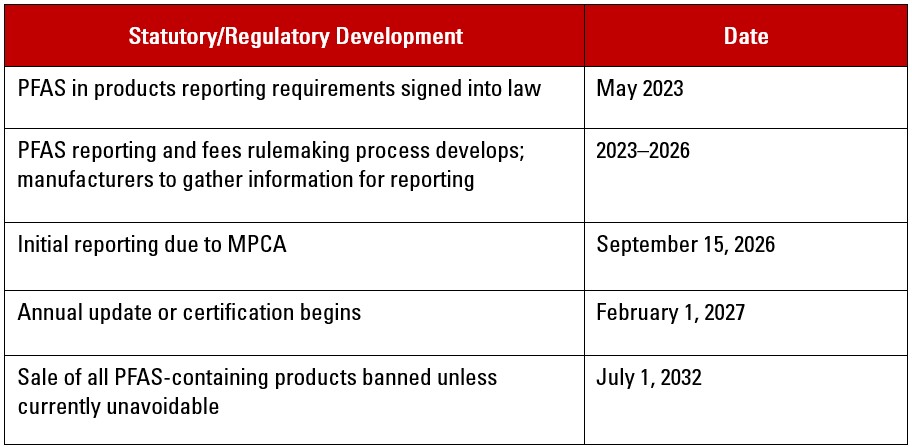
Regulated entities have faced difficulties in preparing to meet PFAS reporting deadlines. So much so that Maine eliminated its initial notification requirement and Minnesota has recently delayed its initial reporting deadline for a second time. On April 15, 2026, the Minnesota Pollution Control Agency (MPCA) extended the initial mandatory reporting deadline under Minnesota’s Amara’s Law (Minn. Stat. § 116.943), which imposes obligations on manufacturers, importers and distributors of products containing intentionally added PFAS. MPCA moved the deadline to September 15, 2026, a two-and-a-half-month extension from the previous deadline, which was July 1, 2026. Subsequent reports will be due yearly to MPCA on February 1. MPCA extended the deadline to provide manufacturers with additional time to understand the new PFAS Reporting and Information System platform.
Manufacturers, importers, brand owners and distributors of products with intentionally added PFAS will be required to report each such product sold, distributed or offered for sale in Minnesota. “Intentionally added” is defined to include any “PFAS deliberately added during the manufacture of a product where the continued presence of PFAS is desired in the final product or one of the product’s components to perform a specific function.” This includes products that the manufacturers sell only online. Manufacturers who are not able to comply with the September 15, 2026 deadline may request a 90-day extension to December 14, 2026. MPCA has provided additional information regarding PFAS reporting, including guidance and tutorials for using the reporting system, on its website.
Amara’s Law is modeled after Maine’s PFAS statute, Me. Rev. Stat. tit. 38, § 1614, which imposed similar requirements. Both states have faced challenges with practical compliance with the statutes, resulting in delayed implementation and modification of the laws. Minnesota’s latest extension will provide manufacturers with additional time to ensure compliance with the Amara’s initial reporting requirements. Nonetheless, for businesses that have not already prepared their initial reporting documentation, it is advisable to proceed with diligence in preparing notification due to the ubiquity of PFAS in consumer, commercial and industrial products. Manufacturers will need to engage in supply chain investigations to discern whether certain forms of products, such as manufactured products without chemical specification sheets, contain PFAS.
For covered products, manufacturers must report the following information to MPCA:
- A description of the product, including its numeric identifier (Universal Product Code (UPC), stock keeping unit (SKU), etc);
- The purpose of the use of PFAS in the product;
- The quantity of each PFAS compound (by weight or concentration);
- The name and address of the manufacturer;
- The name and address of a contact person representing the manufacturer;
- Any additional information that is later required by MPCA rulemaking.
Manufacturers may request permission from MPCA to supply the required information for a category or type of product, in lieu of each individual product. If the information is already publicly available, MPCA may waive all or part of this information from reporting.
Pillsbury is able to assist with preparation of initial reporting, and other aspects of PFAS regulation as compliance deadlines loom.
These and any accompanying materials are not legal advice, are not a complete summary of the subject matter, and are subject to the terms of use found at: https://www.pillsburylaw.com/en/terms-of-use.html. We recommend that you obtain separate legal advice.