Alert 09.19.25
USGS Seeks Comment on 2025 Critical Minerals List to Guide U.S. Mineral Supply Chain Policy
The proposed list maintains past frameworks and methodology and adds new probabilistic assessments of trade disruptions.
Alert
Alert
By Sahar J. Hafeez, Ashleigh K. Myers, M.C. Hammond, Elina Teplinsky
08.12.26
On August 4, 2026, the Department of Commerce’s Bureau of Industry and Security (BIS) issued an unpublished notice, “Defense Priorities and Allocations (DPAS) Directive Allocation Order and Additional Requirements for Recoverable Critical Minerals and Materials (Directive),” requesting comments on a temporary final rule (TFR). The TFR, which implements a Presidential Determination under Title 1 of the Defense Production Act (DPA) broadly authorizing the Commerce Department to impose export restrictions on “recoverable critical minerals and materials” (CMMs). The TFR restricts, effective August 27, 2026, through August 27, 2027, the export of black mass in electrical and electronic waste (e-waste) and tungsten scrap, subject to adjustments and exceptions. This is the first allocation order restricting exports from the Department of Commerce[1] and may foreshadow additional directives targeting other recoverable CMMs, as well as additional authorizations targeting other sectors.
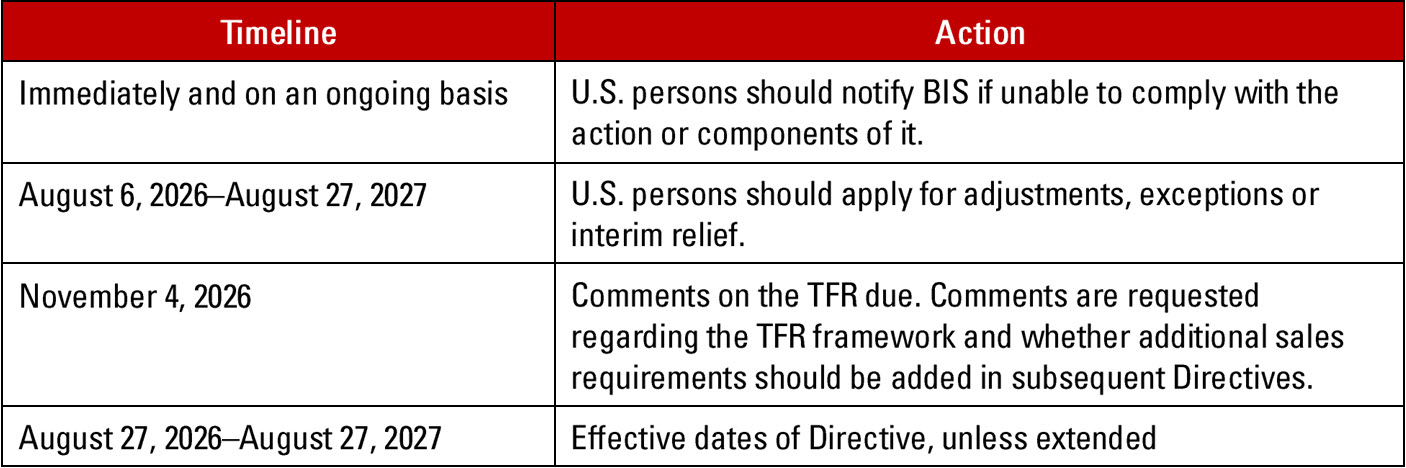
The action is intended to reduce foreign dependencies on critical minerals by incentivizing recovery from finished goods and scrap and providing feedstock for domestic processors. The Directive impacts, among others, tungsten recyclers and scrap processors, scrap dealers and machine-tool recyclers, battery recyclers, black mass processors, e-waste collection companies and OEMs that generate battery and e-waste scrap. Requests for adjustments and exceptions are due on a rolling basis beginning August 6, 2026, through August 27, 2027, and comments on the TFR are due by November 4, 2026.
Below we discuss the key components of the rule (including scope of the restrictions; adjustments, exceptions and interim relief; compliance and enforcement), background, and considerations moving forward.
BIS’s TFR: Components of New Framework
The TFR provides that, effective August 27, 2026, U.S. persons engaged in the sale of the following must allocate 100% of monthly sales to U.S. persons unless an adjustment or exception is obtained from BIS:
The Directive expires one year from its effective date or by August 27, 2027, unless adjusted or extended.
This Directive applies to both rated orders and unrated orders. Generally, DPA Title I authorizes various government agencies, recipients of rated orders (such as contractors) and other persons specifically authorized by an appropriate government agency, to issue rated orders to private industry for production of items or performance of services. The applicable regulations require that “a person shall accept every rated order received and must fill such orders regardless of any other rated or unrated orders that have been accepted.”
Adjustments, exceptions and interim relief
BIS has established a process for authorizing company-specific and generally applicable adjustments or exceptions from the sale requirement. Per the process, companies must submit to BIS via email a request for an adjustment or exception. The request should include facts, circumstances and reasons relevant to seeking relief from the domestic sales requirement and related supporting information. BIS advised that it will consider adjustments, exceptions and interim relief under the following scenarios:
- The domestic sales requirement results in an undue or exceptional hardship on that person not suffered generally by others in similar situations and circumstances;
- The consequence of complying with the domestic sales requirement is contrary to the underlying intent of the action, i.e., because it would reduce the supply of CMMs;
- A U.S. person plans to sell black mass and tungsten waste and scrap to a person located outside the United States for processing or refining, and then the processed/refined material will be returned to the United States;
- Compliance with the domestic sales requirement will result in irreparable harm to a U.S. person subject to the order; and
- Additional time is needed to comply with the domestic sales requirements.
BIS intends to respond to requests for adjustments or exceptions within 14 days of receipt. Requests may be appealed to the Assistant Secretary for Export Administration. BIS may also authorize interim relief through a DPAS temporary license while a request is pending. An approval for an adjustment, exception or interim relief does not impact compliance with U.S. export control regulations.
Compliance and Enforcement
If a U.S. person is unable to comply with the required action, the U.S. person must notify BIS immediately via email (or alternatively, verbally followed by a written or electronic confirmation within one working day) with an explanation regarding the extent to which it can comply and the reasons for which it cannot fully comply. BIS advises that the U.S. person must comply to the fullest extent possible following such notification until otherwise notified by BIS.
BIS will implement the TFR in cooperation with other agencies including U.S. Customs and Border Protection (CBP). CBP may detain materials covered by the Directive intended for export while BIS conducts its review of the shipment. BIS will review and provide notification regarding the disposition of materials covered by the Directive.
BIS may conduct investigations and issue requests for information to enforce compliance with the Directive and applicable laws. BIS may also issue an injunction and failure to comply could result in fines or imprisonment.
Background and Context
DPA Title I, Priorities and Allocation, authorizes the President or a delegated agency head to allocate materials, services and facilities to promote the national defense. Types of allocation orders include:
Allocation orders that “control the general distribution of any material in the civilian market” require the President to find or approve a finding by an agency head that the:
On July 30, President Trump issued a Presidential Determination under which it made such a finding as required by the DPA with respect to recoverable CMMs. “Recoverable CMMs” are broadly defined as black mass, end-of-life, rare-earth permanent magnets or other goods that have fully completed the manufacturing process; swarf; and other waste and scrap containing critical minerals and materials. It does not include copper scrap, which is covered under the Proclamation related to the Section 232 investigation on copper (which we discuss here). “Critical minerals and materials” is broadly defined to include minerals defined in the March 20, 2025, Executive Order, minerals or materials in various U.S. Government lists (including the Department of Defense/War, U.S. Geological Survey and Department of Energy), and any other mineral or material designated by Commerce. (We discuss the lists here and here.) The accompanying Fact Sheet highlights that the United States holds substantial CMMs in finished goods such as lithium-ion batteries and permanent magnets, which could be a source of supply to reduce our foreign dependencies on CMMs once the finished goods reach end-of-life.
Key Considerations Moving Forward
As indicated above, there are several opportunities for stakeholders to engage with BIS with respect to this action, including providing feedback with respect to feasibility of compliance with the Directive; requesting adjustments, exceptions or interim relief; and comments on the overall framework of the rule, as well as whether additional recoverable CMMs should be subject to domestic sales requirements.
To inform engagement on the Directive, companies should consider, among other things:
Key timelines are provided in the table below.
[1] In 2020, in response to the COVID pandemic, the Department of Homeland Security issued an export restriction under DPA Title I covering certain personal protective equipment.