The Decisions
Tianzhu Coal Co. v. Ju (N.Y. App. Div. 2d Dep’t, Aug. 12, 2026). A Chinese coal company held a judgment entered by the Lanzhou Intermediate People’s Court and affirmed by the Gansu High People’s Court. After partial enforcement in China, the claimed unpaid balance was approximately RMB 89.3 million. The creditor proceeded by motion for summary judgment in lieu of a complaint under CPLR 3213 and obtained a New York judgment of approximately USD 12.5 million. The Second Department affirmed. It held that, under the 2021 amendments to CPLR Article 53, the debtor bore the burden of establishing a ground for nonrecognition, while also emphasizing that the amendments did not eliminate the creditor’s ordinary summary-judgment burden. The debtor’s affidavit and four expert affirmations were too conclusory and speculative to raise a triable issue concerning the fairness of the Chinese judicial system.
Shenzhen Qianhai Shengshi Lijin Investment Enterprise v. Xu (N.Y. App. Div. 2d Dep’t, July 8, 2026). The Second Department held that the defendants’ reliance on the U.S. State Department’s 2018 and 2019 China Country Reports, standing alone, did not require dismissal of the recognition claim. But the court also reversed the trial court’s early recognition and attachment rulings. Because the action began before the 2021 amendments, the earlier burden rules applied. The creditor’s summary-judgment cross-motions were premature because issue had not been joined, and its submissions did not make the required prima facie showing concerning the Chinese judicial system. The court also found the attachment evidence insufficient. The decision underscores that a viable recognition claim can still fail at a particular stage because of motion timing, translation defects or an inadequate evidentiary record.
Northeast Securities Co. v. Que (Cal. Ct. App. 6th Dist., June 2025) (unpublished). A Chinese securities company sought recognition of a judgment entered by the Jilin High People’s Court. In an unpublished opinion that generally may not be cited under California Rule of Court 8.1115, the Sixth District affirmed right-to-attach orders covering California property. The court concluded that substantial evidence supported the probable validity of the recognition claim and that attachment could supply quasi-in-rem jurisdiction over property in California. The opinion did not finally recognize the Chinese judgment; it affirmed provisional attachment orders while the recognition action remained pending.
Shanghai Yongrun Investment Management Co. v. Xu (N.Y. App. Div. 1st Dep’t, Nov. 2025). In an action involving a RMB 64 million Beijing judgment, the First Department reinstated an extrinsic-fraud defense and allowed related discovery. The debtor alleged that a Chinese government official coerced him to sign the underlying agreement and that the threat remained in force during the Chinese proceedings, preventing him from presenting that defense there. The court did not deny recognition; it held only that the allegations were sufficient at the pleading stage. It separately rejected the debtor’s public-policy defense because an ordinary breach-of-contract claim is not repugnant to New York public policy.
What the Decisions Show
Recognition is available, but it is not automatic. Recent appellate decisions reject the proposition that a Chinese judgment is categorically unenforceable in the United States. They do not, however, make recognition routine in every case. A creditor still must establish that the judgment falls within the governing statute and must comply with the forum’s procedural and evidentiary rules.
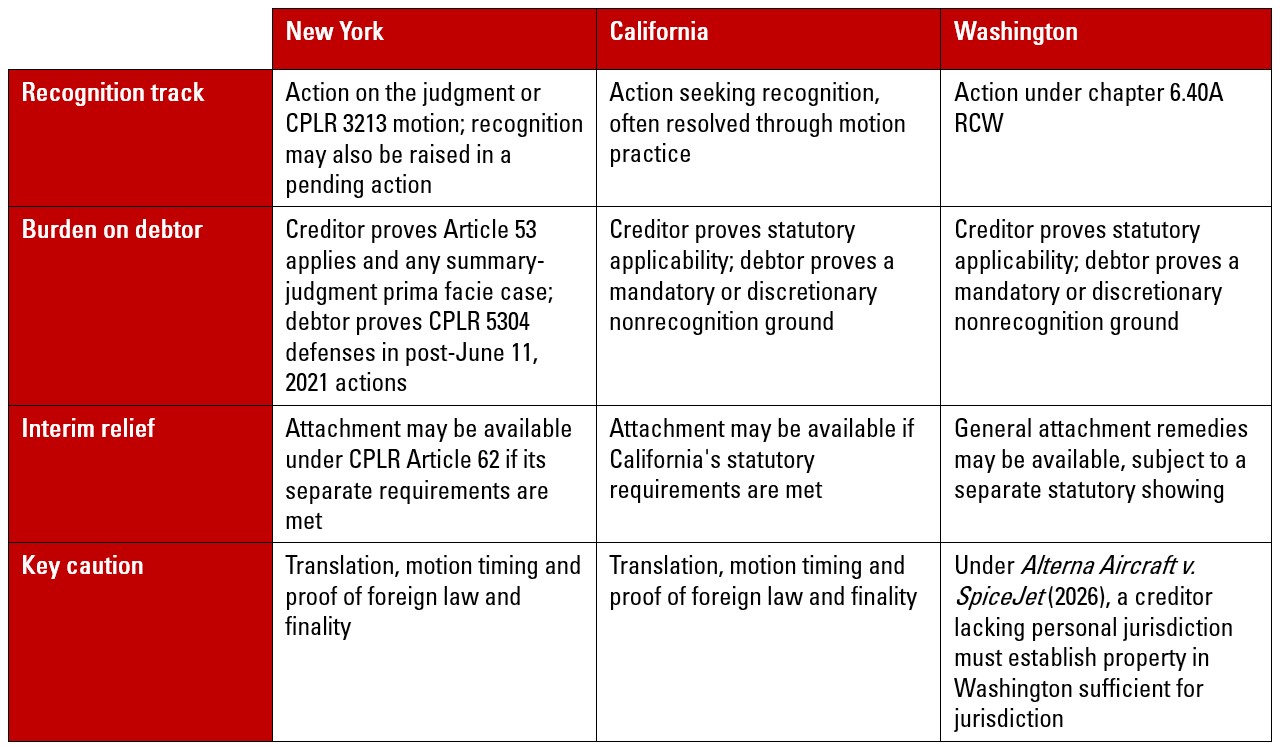
New York’s 2021 amendments clarified the burdens. For actions commenced on or after June 11, 2021, the creditor bears the initial burden of showing that Article 53 applies—including that the judgment grants or denies a sum of money and is final, conclusive and enforceable where rendered. If the creditor seeks CPLR 3213 relief, it must also establish a prima facie entitlement to summary judgment. The debtor then bears the burden of proving a ground for nonrecognition under CPLR 5304.
Procedure can determine the outcome. The recent cases turn on issues such as whether summary judgment was sought before issue was joined, whether translations complied with local rules, whether foreign law and finality were adequately proved and whether the attachment record contained facts rather than suspicion. These are not housekeeping details; they can decide whether relief is granted, delayed or denied.
The defense playbook is narrower and more evidence-driven. Generalized criticism of China’s courts is unlikely to carry the day without competent, case-linked proof. More focused defenses remain available, including lack of notice, lack of jurisdiction, extrinsic fraud that deprived the debtor of a fair opportunity to present its case, substantial doubt about the integrity of the rendering court in the particular matter and procedures in the specific case that were incompatible with due process.
Recognition and collection are separate. A recognition judgment gives the creditor a domestic judgment that can be enforced under local law; it does not identify assets or transfer funds. Asset tracing, provisional remedies, post-judgment discovery, turnover proceedings, garnishment, receivership and fraudulent-transfer claims may still be necessary.
How Recognition Works, in Brief
Recognition is not a retrial of the underlying dispute. It is a statutory proceeding focused on the judgment’s eligibility for recognition and any permitted grounds for nonrecognition. The precise procedure varies by state, but the core steps are similar:
- Choose the forum and file correctly. Confirm the forum’s jurisdiction over the debtor or relevant property, check the limitations period and use the procedure authorized by local law. New York permits an action on the judgment or a CPLR 3213 motion for summary judgment in lieu of complaint.
- Serve the debtor. Comply with the forum’s service rules and any applicable treaty. When documents must be served in mainland China and the recipient’s address is known, service ordinarily proceeds through the Hague Service Convention’s Central Authority channel. China has objected to the alternative methods in Article 10, including service by postal channels.
- Establish the judgment. Submit an authenticated or otherwise admissible copy of the judgment, competent proof that it is final, conclusive and enforceable in China, compliant English translations and any necessary expert evidence on Chinese law.
- Address nonrecognition defenses. Build the record on notice, jurisdiction, representation, opportunity to be heard, appeals and enforcement history. The allocation of burdens depends on the governing statute and, in New York, when the action was commenced.
- Collect. If the statutory requirements are met, seek attachment or other provisional relief, obtain recognition and then use domestic enforcement tools against identified assets and transfers.
Timing varies materially. An uncontested matter may be resolved in months, but service abroad, disputes over foreign law, expert evidence, discovery, provisional-relief proceedings and appeals can extend the process substantially. Hague Service Convention requests to China often take many months, so service planning should begin early.
Choosing a Forum: The Leading Venues at a Glance
What Creditors Should Do Now: The First 90 Days
- Map the U.S. assets. Identify real property, corporate interests, UCC filings, bank relationships, litigation history and transfers to family members, trusts or affiliates. Asset location will drive forum choice and collection strategy.
- Check deadlines and jurisdiction before filing. New York requires an action within the earlier of the period during which the judgment remains effective in China or 20 years after it became effective. California generally uses the earlier of the foreign enforceability period or 10 years. Other states differ. Confirm that the chosen court also has the necessary connection to the debtor or property
- Assemble the judgment package. Collect an authenticated or otherwise admissible copy of the Chinese judgment, proof of finality and enforceability, any appellate or enforcement rulings, compliant English translations and the necessary evidence of Chinese law.
- Preserve the procedural record. Gather proof of service and notice in China, hearing records, appearances, counsel’s participation, evidence submissions, appellate rights and enforcement history. A clear record can neutralize due-process and fraud defenses before they gain traction.
- Choose the state deliberately. Weigh asset location, the recognition statute, fraudulent-transfer reach-back and fee-shifting. File where the combination is strongest.
- Start service early. If the debtor must be served in mainland China, prepare Hague Convention materials and translations promptly. If the debtor is elsewhere, determine which treaty and local service rules apply rather than assuming that alternative service will be available.
- Coordinate recognition and collection. Plan post-recognition discovery, turnover, garnishment and fraudulent-transfer claims at the outset. Recognition is most valuable when it is paired with a realistic route to assets.
Reciprocity Is Developing in Both Directions
Chinese courts have also recognized U.S. judgments. A Wuhan court did so in 2017, and a reported October 2024 decision of the Wuxi Intermediate People’s Court recognized and enforced a California fraud judgment of approximately USD 73.4 million. China’s amended Civil Procedure Law, effective January 1, 2024, provides a clearer framework for foreign judgments in Articles 298 through 303. These developments strengthen reciprocity arguments in U.S. states where reciprocity matters, but the effect remains state-specific and should be assessed under the forum’s statute.
Recognition is an important milestone, not the end of the recovery process. Successful creditors treat enforcement as a coordinated campaign: identify and, where possible, preserve assets; build a complete recognition record; obtain a domestic judgment; and move promptly into collection. Delay can allow assets to be transferred, encumbered or spent.
How We Can Help
Our China practice team, which is comprised of an experienced cross-border litigation and asset recovery team, represents judgment creditors and debtors in recognition and enforcement proceedings across the United States, including asset tracing, attachment, post-judgment discovery and fraudulent-transfer litigation. If you hold a Chinese judgment, or face one, and U.S. assets are involved, please contact us.