Alert 03.13.26
DEI Compliance Remains an Active Concern (UPDATED)
Recent admissions transparency reporting requirements and enforcement activity highlight the continued need for targeted, privileged risk assessments.
Alert
Alert
03.30.26
On March 26, 2026, the White House issued an Executive Order (EO) titled “Addressing DEI Discrimination by Federal Contractors.” The EO states that its purpose is to promote economy and efficiency in federal contracting by preventing racial discrimination. Although prior executive orders have referred to “illegal DEI,” that term was not defined. This new EO defines “racially discriminatory DEI activities” to mean “disparate treatment based on race or ethnicity in recruitment, employment (e.g., hiring, promotions), contracting (e.g., vendor agreements), program participation, or allocation or deployment of an entity’s resources.” The term “program participation” is further defined to mean “membership or participation in, or access or admission to: training, mentoring, or leadership development programs; educational opportunities; clubs; associations; or similar opportunities that are sponsored or established by the contractor or subcontractor.”
Within 30 days of the EO (i.e., by April 1, 2026), agencies are directed to ensure that covered contracts and contract-like instruments, as well as lower tier subcontracts, include a clause requiring the contractor or subcontractor to certify that, “in connection with the performance of work under this contract,” the contractor “will not engage in any racially discriminatory DEI activities” as defined in the EO. The clause also will impose associated information-access and reporting obligations, a requirement for contractors to report subcontractor noncompliance to the contracting agency, a requirement for contractors to inform the agency if a subcontractor files a lawsuit that “puts at issue, in any way, the validity of this clause,” and an express statement that “compliance with the requirements of this clause are material to the Government’s payment decisions” under the False Claims Act. The Federal Acquisition Regulatory Council is directed to issue deviation and interim guidance within 60 days while formal Federal Acquisition Regulatory amendments are pursued.
The EO signals that the administration plans active and targeted enforcement. Penalties for noncompliance with the mandated certifications include contract termination, suspension or debarment of contractors or subcontractors, as well as civil or criminal penalties under the False Claims Act. In addition, the EO directs the Director of the Office of Management and Budget, the Attorney General, the Assistant to the President for Domestic Policy, and the Chairman of the Equal Employment Opportunity Commission to “identify economic sectors that pose a particular risk of entities engaging in racially discriminatory DEI activities based on current or past conduct and issue additional guidance to contracting agencies regarding best practices to ensure compliance with this order within such sectors.”
The EO does not, on its face, apply to all recipients of federal financial assistance. Unlike the memo issued by the Department of Justice in July 2025 (“DOJ Memo”), which addressed federal-funding recipients more broadly, this EO operates through federal procurement terms. For institutions that both receive federal funds and hold federal contracts or subcontracts, the new regime layers contract-specific risk on top of an already active civil-rights enforcement environment.
Organizations holding or seeking federal grants or other federal funding should also continue to monitor a proposed revision by the General Services Administration (GSA) to the Financial Assistance General Certifications and Representations used in SAM.gov, which is the registration system for federal grants, loans, and other forms of federal financial assistance. The January 28, 2026, Federal Register notice of the proposed change states that the revisions are intended to “align with updated executive branch guidance,” including the DOJ Memo and EO 14173, titled “Ending Illegal Discrimination and Restoring Merit-Based Opportunity.” The proposed revisions would require certification of compliance with all federal laws and relevant executive orders “prohibiting unlawful discrimination on the basis of race or color in the administration of federally funded programs,” and lists “examples” of “practices that may violate applicable Federal anti-discrimination laws” (emphasis added) which closely track the DOJ Memo. These are:
Notably, the examples in GSA’s proposed revisions do not include any of the “Potentially Unlawful Proxies” identified in the DOJ Memo, such as recruitment strategies targeting specific geographic areas, institutions, or organizations because of their racial or ethnic composition.
In light of both the new EO and the proposed new certification requirements for entities registering to receive other forms of federal financial assistance, even organizations that do not receive any federal funding but are subject to other federal antidiscrimination laws may also take note of how the EO defines “racially discriminatory DEI activities.”
From Prior Certification to Contractual Enforcement
Earlier administration actions required contractors to certify that they did not operate DEI programs that violate applicable Federal anti-discrimination laws. In defending those measures, the administration argued that the certification reached only conduct that was already unlawful and that the administration was not contending that all DEI activity is unlawful. That position figured prominently in the Fourth Circuit’s recent decision vacating a preliminary injunction against Executive Order 14173. The new EO is different in an important respect. Rather than only incorporating existing anti-discrimination law by reference, it directs agencies to insert a contract clause keyed to the EO’s own definition of “racially discriminatory DEI activities.”
That shift matters. Because the certification expressly incorporates the EO’s own definition, contractors may have less room in some cases to rely on a generalized good-faith view that a challenged practice was lawful under prior guidance. As explained in our previous alert about the Department of Justice’s Civil Rights Fraud Initiative, one key defense against False Claims Act liability is if the defendant lacked actual knowledge and subjective beliefs—or scienter—that their conduct was unlawful. By requiring contractors to certify that they do not engage in discriminatory practices as defined in the EO itself, prosecutors may seek to weaken scienter defenses.
In addition, the EO also requires prime contractors to report known or reasonably knowable subcontractor conduct that may violate the clause and to notify the government if a subcontractor challenges the clause in litigation.
The Ambiguities That Matter Most
Two features of the EO are likely to generate immediate questions. First, what are the limitations regarding “recruitment”? Since the 1964 enactment of Title VII, it has been unlawful to adopt racially exclusionary recruiting criteria, such as publishing “Whites Only” job advertisements. It has not been considered unlawful disparate treatment for employers posting jobs that are open to all qualified applicants to engage in targeted outreach to underrepresented communities. Rather, at least in some settings, that was widely understood to be a best practice. In 2023, for example, EEOC and the Department of Labor’s Office of Federal Contract Compliance Programs (OFCCP) HIRE materials identified as promising recruitment practices engaging with minority-serving institutions, among other resources, as well as using social media to reach diverse audiences. For federal contractors subject to the now-revoked EO 11246, OFCCP regulations required them to engage in and describe their “good faith efforts” to address “underutilization” of women and minorities in any job group; such efforts often included outreach to new recruiting sources, such as posting jobs with affinity groups for the industry or participating in career fairs at colleges and universities with larger minority student bodies. Even though these regulations no longer apply to federal contractors in the Trump Administration, that such practices were until recently part of legal compliance efforts suggests that such now-voluntary efforts should not be considered “discriminatory DEI.” The new EO, however, does not explain whether “racially discriminatory” recruitment is limited to overt race-based restrictions or quotas, or whether agencies may take a broader view—especially given statements in the DOJ Memo cautioning that facially neutral criteria or practices can operate as unlawful proxies for discrimination on the basis of protected traits.
Second, what are the limitations regarding “program participation”? The EO defines that term broadly to include training, mentoring, leadership development, educational opportunities, clubs, associations and similar opportunities sponsored or established by the contractor or subcontractor. That leaves open whether the administration will target only programs with express race-based eligibility or also programs that are open to all, but that are aimed at addressing underrepresentation of certain demographic groups. The same question applies to supplier and vendor initiatives, internships, fellowships, leadership pipelines and affinity programming. Race-exclusive eligibility criteria pose the clearest legal risk. But programs that are formally open to all while designed, described or resourced in ways a regulator could characterize as proxy-based or race-preferential may also draw attention.
Given the broad theories around what constitutes unlawful discrimination advanced in the DOJ Memo and other federal guidance—including proxy-discrimination theories, a narrow reading of the new EO by the administration should not be assumed.
Public-Facing Materials and Third-Party Relationships
As we have discussed recently DEI-related enforcement activity has often begun with publicly accessible websites, job postings, program descriptions, media reporting or third-party complaints. That dynamic is likely to carry over here. The EO expressly contemplates agency access to information and reports, prime-contractor reporting regarding subcontractor conduct and prompt consideration of private False Claims Act suits. Public-facing diversity, supplier, mentoring and leadership statements—particularly where they appear to promise race-based preferences or reserved opportunities—may become exhibits in complaints, referrals or whistleblower allegations before an agency ever makes a formal inquiry.
Moreover, the EO’s “books and records” provision provides an additional enforcement tool by obligating contractors to “furnish all information and reports, including providing access to books, records, and accounts” upon agency request. Although such audit provisions are common in non-commercial government contracts, and particularly in cost-type contracts, the EO appears to expand government audit rights to commercial item contracts. Because government audits are expensive endeavors, such audits will likely lead contractors to seek equitable adjustments under the Changes clause to compensate them for the additional costs. For those contractors that are not accustomed to government audits, this new contract provision essentially conditions continued contract performance on compliance with potentially broad information requests. As with prior litigation over OFCCP compliance reviews of contractor affirmative action programs, some contractors may choose to challenge the scope of administration audits as unduly burdensome or overbroad. That is a difficult showing to make, however, when documents requested by an agency are ones that a contractor is required by law or contract to maintain, as noted in a 2022 Department of Labor Administrative Review Board decision. (That decision held that OFCCP requests for data for off-site review must meet the Fourth Amendment standard for administrative subpoenas set forth in a 1984 Supreme Court case, Donovan v. Lone Steer, which require a request be “limited in scope, relevant in purpose, and specific in directive so that compliance will not be unreasonably burdensome.”) Contractors, thus, could face a choice between complying with potentially extensive government audits or risk termination, suspension, or debarment.
What Contractors Should Do Now
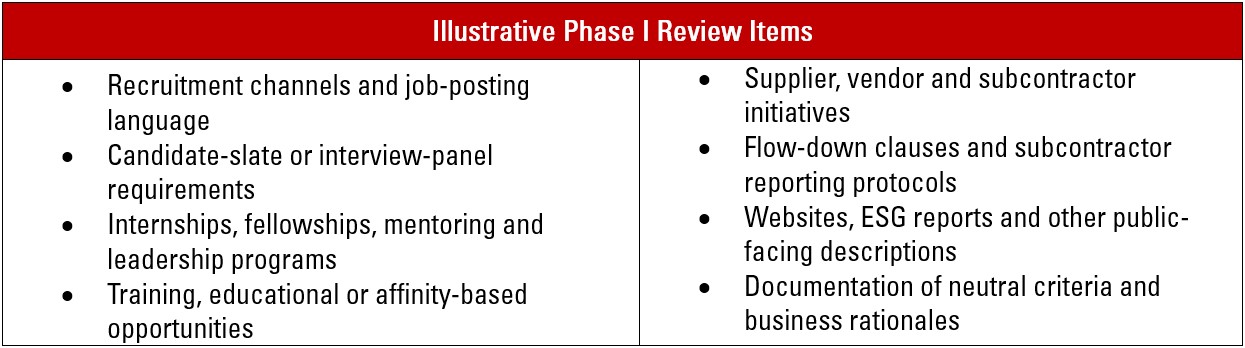
Contractors should consider a privileged, targeted review of relevant policies and procedures now, particularly those that are public-facing, before clause rollout and sector-specific guidance. Priority items likely include: recruitment strategies and candidate-slate requirements; internships, fellowships, mentorships and leadership-development programs; supplier or vendor initiatives; subcontract flow-down language and escalation protocols; webpages, ESG reports, job postings and other public messaging; and documentation showing neutral eligibility criteria and legitimate business rationales.
Contractors should also think ahead about information requests. The EO requires contractors to furnish information and reports, including access to books, records and accounts, as required by the contracting agency. How aggressively that authority will be used will depend on implementation and existing legal limits on administrative demands. Even so, recordkeeping discipline, centralized review of higher-risk descriptions and documentation of non-discriminatory rationales could be critical. Colleges and universities, a sector that has already often been the target of Trump administration civil rights enforcement actions, may find it particularly prudent to consult with legal counsel proactively, given the EO’s directive for agency heads to compile a list of “economic sectors that pose a particular risk” of being considered to violate the EO’s definition of racially discriminatory DEI practices.
Conclusion
The March 26 EO does not answer every compliance question, and further guidance should be expected. As with prior executive orders and agency actions, the EO and its implementation, as well as the new SAM.gov certification requirements, may be subject to legal challenges. Unfortunately for contractors and other recipients of federal funding seeking clarity on how to minimize risk, they may be subject to these requirements long before those legal challenges are ultimately resolved.
At a minimum, the new EO clearly signals a shift from broad anti-DEI policy statements to enforceable federal contract terms. Contractors, especially institutions with decentralized programs and legacy public-facing content, should move now to identify the highest-risk touchpoints, align subcontract language and reporting channels, and prepare for a contracting environment in which DEI-related representations may be tested not only through civil-rights complaints, but also through contract remedies and False Claims Act theories.
Pillsbury advises clients on civil rights compliance, government-contracting risk, governance and high-stakes investigations and litigation. Our experience includes privileged risk assessments, leadership counseling and defense of discrimination and other civil rights matters.
Pillsbury monitors developments like these. These updates are posted on Pillsbury’s DEI Compliance, Counseling & Defense practice webpage, Government Contracts & Disputes webpage, Trump 2.0 Resource Center, and Education webpage. If you did not receive this from Pillsbury and would like to receive future alerts, you can subscribe to Pillsbury Insights.