Blog Post 01.23.25
Alert
OCC Issues New Supervisory Framework for Banks’ Use of AI, Emphasizing Risk-Based Oversight
The new framework outlines how examiners may evaluate banks’ use of AI, with supervisory attention calibrated to the potential consequences of tool failure, scope of autonomous actions and degree of human oversight.
Alert
By Andrew Caplan, Brian H. Montgomery, Mia Rendar, Diana Obinna
Takeaways
11.20.26
On November 4, 2026, the Office of the Comptroller of the Currency (OCC) issued Bulletin 2026-54, “Super Intelligence: Supervisory Framework” (the “Framework”) outlining how its examiners may evaluate banks’ use of AI in ordinary business activities, including credit decisioning, payments, fraud detection, customer service, cybersecurity and risk management.
Consistent with the White House’s preferred nomenclature, the OCC refers to AI as “super intelligence” (SI) throughout the Framework, which is primarily directed toward generative and agentic AI systems.
Generative AI refers to a subset of machine-based systems designed to use artificial neural networks to analyze large data sets and generate unique outputs. Since its emergence, generative AI has been adopted across the banking sector at a pace that rivals the earlier spread of symbolic, rules-based AI, which long underpinned functions such as fraud detection, credit scoring and transaction monitoring. Today, generative AI tools are becoming commonplace, particularly for internal productivity and customer support applications, with industry and supervisory attention shifting toward more autonomous, agentic AI.
In contrast, agentic AI refers to systems capable of independently planning and executing tasks, making decisions and interacting with other systems with varying, limited degrees of human intervention. Unlike traditional generative AI tools, which generally respond to user prompts by producing content or recommendations (that a human user must take independent action on), agentic AI is designed to take actions to accomplish defined objectives without direct, contemporaneous human involvement. (See more on the risks of agentic AI compared to non-agentic tools here.)
The Framework applies a technology-neutral, risk-based approach to AI governance. Rather than treating AI as a distinct category of risk, it recognizes that AI can introduce, amplify or modify existing operational, compliance, credit and other banking risks. Although the OCC expressly states that the Framework does not establish new supervisory expectations or enforceable standards, the Framework does provide insight into areas that the OCC may review during examinations, such as agent permissions, testing, auditability, operational resilience and third-party vendor arrangements.
The Framework’s overarching principle is that the intensity of controls should be proportionate to the potential consequences of an AI system’s failure or misuse. Higher-risk applications may warrant greater restrictions on autonomy, stronger human oversight, more extensive testing and enhanced operational safeguards. Importantly, the OCC emphasizes that risk should be assessed based on the consequences of an AI system’s actions and the degree of authority delegated to it, rather than the sophistication of the underlying technology. For example, a simple agent vibe-coded by an individual user that has the capability to initiate financial transactions could present greater risk than a sophisticated generative AI system used solely for internal workplace productivity assistance.
Financial Institutions’ Growing Deployment of Agentic AI Drives the Guidance
Recent industry research suggests that financial institutions are increasingly deploying AI agents, although most applications continue to operate with limited autonomy. Efforts are often focused on internal-facing operational support systems, but client-facing avatars are being utilized in limited external use cases such as customer support. Indeed, though limited to the UK financial services industry, an October 2026 survey by the Bank of England and UK Financial Conduct Authority found that 80% of surveyed financial services firms reported having AI agents deployed, but only 2% reported deploying agents with broad autonomy.
Inbound agents remain a major issue for financial institutions, with recent findings that “rogue” agents are disproportionately popping up in client accounts. A key distinction emerging from these developments is between informational (“read”) access, where an agent retrieves account information, and transactional (“write”) access, where an agent can initiate payments or transfer funds. Granting agents transactional authority raises more significant authorization, security and liability concerns.
Overall, the guidance may provide financial institutions with a roadmap for more consequential deployments of AI systems.
Six Pillars of the OCC’s Supervisory Framework
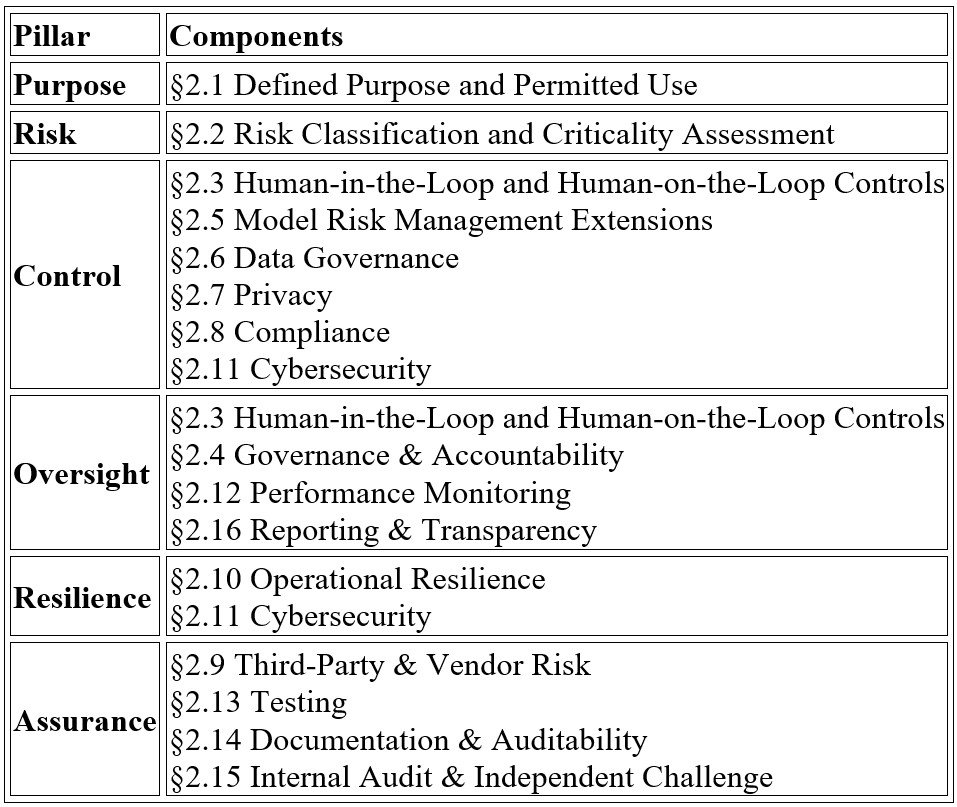
The OCC presents six principal pillars addressing how banks identify, manage and oversee AI-related risks. Those pillars are:
- Purpose. Defining an AI system’s intended use and permitted activities
- Risk. Evaluating the consequences of AI failures or inappropriate actions, such as whether the action or decision is explainable and reversible
- Control. Identifying safeguards against unauthorized or unsafe actions, which requires human-in-the-loop or human-on-the-loop oversight. Human-in-the-loop means securing human approval before an action, while human-on-the-loop involves ongoing human monitoring with the ability to intervene.
- Oversight. Establishing accountability for AI systems
- Resilience. Assessing the ability to detect, contain and recover from AI system failures or misuse
- Assurance. Evaluating whether controls remain effective through testing, documentation, auditability, independent review and third-party oversight
The Framework breaks these pillars down into 16 supervisory components, with a summary of the pillars and components below:
Risk Classification: Greater Autonomy and Consequence May Warrant Stronger Controls
The Framework also introduces an illustrative four-tier risk classification methodology, ranging from low-risk internal productivity tools to highly autonomous systems capable of taking consequential financial actions. This classification methodology is used to score each AI use case against a consistent set of factors, so that comparable risk translates to comparable controls.
At the lower end, Tier 4 covers general employee assistance and internal productivity tools that do not directly affect customer or financial data. Tier 3 includes decision-support applications subject to mandatory human review, such as document summarization for credit memoranda. Tier 2 covers higher-impact applications, including AI-assisted underwriting and agent-initiated customer communications. Tier 1 encompasses critical applications, such as autonomous payment agents, real-time credit decisioning and fraud-hold releases.
These classifications are illustrative rather than mandatory. They underscore the OCC’s emphasis on distinguishing AI systems that provide information or recommendations from those authorized to take direct action, particularly where actions may be difficult to reverse or could have significant financial or customer consequences.
Implications for Banks and Technology Providers
Although the Framework is intended for examiners, it identifies considerations that banks and their technology providers may find relevant when evaluating AI governance and vendor arrangements. In particular, the OCC’s discussion of third-party risk management expressly addresses agent authority, incident notification, contractual liability and changes to AI functionality.
For banks using AI technologies, key considerations include:
- Aligning Governance to the Risk Tiers. Banks should consider whether their AI inventories and governance processes classify each use case against the Framework’s illustrative four-tier methodology. Banks may also consider whether their processes require reclassification when a use case’s autonomy, access or customer impact changes, and whether vendor agreements reflect the tier of the services provided, so that higher-tier deployments carry correspondingly stronger contractual protections.
- Agent Authority and Human Oversight. Banks should consider whether AI governance frameworks and vendor agreements clearly define the scope of an agent’s capabilities, together with the controls in place to ensure those boundaries are not exceeded. The Framework suggests a level of human involvement calibrated to the consequences, and distinguishes between human-in-the-loop controls and human-on-the-loop controls. Some practical examples of controls that may help satisfy this include establishing agent access only to non-production environments, limiting access to sensitive information, and requiring user approval before a connector is established to complete a task.
- Monitoring, Testing and Auditability. The Framework identifies considerations for testing AI systems before and after deployment, monitoring changes in performance, and maintaining records sufficient to reconstruct material decisions and actions. Banks should evaluate whether vendor agreements provide appropriate access to activity logs, testing information and documentation needed for internal oversight and regulatory examinations.
- Third-Party Risk Management and Liability. Banks should assess privacy, cybersecurity and other risks arising from external AI solutions, service providers and integrations. The OCC suggests that banks consider including contractual provisions addressing the scope of authority granted to third-party AI agents, AI-specific incident notification requirements, responsibility for model-related errors and customer losses (including indemnification and liability caps), and notice of changes to AI models or functionality. Banks may consider whether existing vendor agreements adequately address these issues based on the nature and risk of the relevant AI use case. The guidance, of course, does not prescribe what the appropriate allocation of responsibility is, but does suggest establishing clarity on that allocation.
- Operational Resilience and Intervention. For more consequential AI use cases, the Framework discusses safeguards such as circuit breakers, rate limits, suspension capabilities and tested recovery procedures. Banks should consider whether their technical and contractual arrangements support timely intervention when autonomous systems behave unexpectedly or exceed their authorized scope. Creating AI-specific incident response mechanisms, or ensuring that AI-risk is accounted for in existing incident response procedures, is an excellent first step to sound intervention.
Recommended Actions
The OCC’s Framework is the clearest signal yet of how examiners are likely to evaluate agentic AI: by asking what an agent is authorized to do, who is watching it and what happens when it gets something wrong.
Banks that can answer those questions now—through current AI inventories, tier-appropriate controls and vendor agreements that clearly allocate authority, notice and responsibility—will be better positioned to deploy the next generation of autonomous tools in light of regulatory expectations. Because AI vendor relationships are often negotiated well before deployment, upcoming renewals and new procurements offer a timely opportunity to build these protections in, rather than retrofit them after an examiner or an incident exposes the gap.
Pillsbury’s Global Sourcing and Technology Transactions team is available to assist banking clients in evaluating agentic AI risks, reviewing AI governance and third-party contracting frameworks, and negotiating contractual protections responsive to evolving regulatory expectations.
These and any accompanying materials are not legal advice, are not a complete summary of the subject matter, and are subject to the terms of use found at: https://www.pillsburylaw.com/en/terms-of-use.html. We recommend that you obtain separate legal advice.